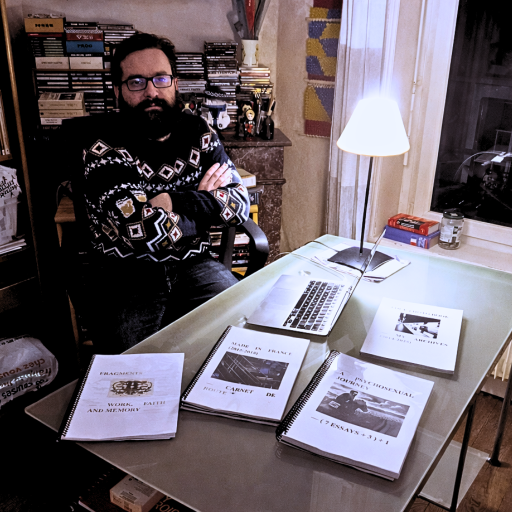
I got “Beowulf” in a small library in my hometown Nancy — East of France. It was a bilingual edition : Modern English and Old English. It reminded me of the book “Pantagruel” — written by François Rabelais — I got one time in Paris : Modern French and Old French. It was a bit of a mystery. The word “Beowulf” echoed in my mind, some kind of mystical creature. I was amazed to read one of the oldest poems of Old English literature — which is the main reason I bought it, as I often do with other cultures like the “Enuma Elish” for the Sumerians, also the “Hebrew Bible”. I will explore poetry, literary works and also official documents like the “Domesday Book” or classics like “The Canterbury Tales”.
J’ai découvert « Beowulf » dans une petite bibliothèque de ma ville natale, Nancy, dans l’est de la France. C’était une édition bilingue : anglais moderne et anglais ancien. Cela m’a rappelé le livre « Pantagruel » — écrit par François Rabelais — que j’avais trouvé un jour à Paris : français moderne et français ancien. C’était un peu mystérieux. Le mot “Beowulf” résonnait dans mon esprit, comme une sorte de créature mystique. J’ai été émerveillé par la lecture de l’un des plus anciens poèmes de la littérature en ancien anglais, la principale raison pour laquelle je l’ai acheté, comme je le fais avec d’autres cultures, par exemple « Enuma Elish » pour les Sumériens, ou encore la « Bible hébraïque ». Je vais explorer la poésie, les œuvres littéraires, mais aussi des documents officiels comme le « Domesday Book » ou des classiques comme « Les Contes de Canterbury ».
∘ Typologies of Old English Poetry
∘ Brief history of Old and Middle English
∘ Beowulf
∘ Wonders of the East
∘ The Canterbury Tales
∘ Domesday Book
∘ Exeter Book
∘ Anglo-Saxon Chronicle
∘ Caedmon’s Hymn, The Dream of the Rood, The Battle of Maldon, The Seafarer and Lacnunga
∘ Legacy of Old English literature
Typologies of Old English Poetry
Old English poetry can be broadly divided into several typological categories reflecting its themes, functions, and styles. The epic poetry (heroic poetry) celebrates legendary deeds, heroic values, and warrior ethos, as seen in Beowulf or The Battle of Maldon. The elegiac poetry expresses themes of exile, loss, and transience, blending pagan fatalism with Christian hope; The Wanderer and The Seafarer are the best-known examples. Religious poetry includes both biblical paraphrases and visionary poems such as The Dream of the Rood or Cædmon’s Hymn, illustrating the Christianization of the vernacular tradition. Another distinctive genre is riddle poetry, found in the Exeter Book, which uses metaphor and wordplay to challenge the reader’s perception of the world. Finally, some texts belong to didactic and magical poetry, like the charms in Lacnunga, combining poetic rhythm with ritual and healing functions. Across all these forms, Old English poetry is characterized by alliterative verse, the use of kennings, and a deep sense of wyrd — fate — shaping both human life and the cosmos.
La poésie anglaise ancienne peut être divisée en plusieurs catégories typologiques reflétant ses thèmes, ses fonctions et ses styles. La poésie épique (poésie héroïque) célèbre les exploits légendaires, les valeurs héroïques et l’éthique guerrière, comme on le voit dans Beowulf ou La Bataille de Maldon. La poésie élégiaque exprime les thèmes de l’exil, de la perte et de l’éphémère, mêlant le fatalisme païen à l’espoir chrétien ; The Wanderer et The Seafarer en sont les exemples les plus connus. La poésie religieuse comprend à la fois des paraphrases bibliques et des poèmes visionnaires tels que The Dream of the Rood ou Cædmon’s Hymn, illustrant la christianisation de la tradition vernaculaire. Un autre genre distinctif est la poésie énigmatique, que l’on trouve dans l’Exeter Book, qui utilise des métaphores et des jeux de mots pour remettre en question la perception du monde par le lecteur. Enfin, certains textes appartiennent à la poésie didactique et magique, comme les charmes de Lacnunga, qui combinent le rythme poétique avec des fonctions rituelles et curatives. À travers toutes ces formes, la poésie anglo-saxonne se caractérise par des vers allitératifs, l’utilisation de kennings et un sens profond du wyrd — le destin — qui façonne à la fois la vie humaine et le cosmos.
Brief history of Old and Middle English
Old English, spoken roughly from 450 to 1100, was the language of the Anglo-Saxon kingdoms formed after Germanic migrations to Britain following the Roman withdrawal. It was a highly inflected language with a Germanic vocabulary enriched by Latin borrowings after the Christianization of England in the 7th century. Its literature, composed mainly in alliterative verse, includes heroic epics like Beowulf and elegies such as The Wanderer, blending pagan ideals with Christian faith. The Norman Conquest of 1066 transformed the linguistic landscape: French became the language of the elite, and English gradually evolved into Middle English (1100–1500). During this period, the language underwent grammatical simplification, absorbed many French and Latin words, and developed strong dialectal diversity before a London-based standard began to emerge. Middle English literature flourished in works like Chaucer’s The Canterbury Tales, Piers Plowman, and Sir Gawain and the Green Knight, signaling the revival of vernacular writing and paving the way toward Modern English in the Renaissance.
L’anglais ancien, parlé approximativement de 450 à 1100, était la langue des royaumes anglo-saxons formés après les migrations germaniques vers la Grande-Bretagne à la suite du retrait des Romains. C’était une langue très flexible avec un vocabulaire germanique enrichi par des emprunts au latin après la christianisation de l’Angleterre au VIIe siècle. Sa littérature, composée principalement de vers allitératifs, comprend des épopées héroïques comme Beowulf et des élégies comme The Wanderer, mêlant les idéaux païens à la foi chrétienne. La conquête normande de 1066 a transformé le paysage linguistique : le français est devenu la langue de l’élite, et l’anglais a progressivement évolué vers le moyen anglais (1100–1500). Au cours de cette période, la langue a subi une simplification grammaticale, a absorbé de nombreux mots français et latins et a développé une forte diversité dialectale avant qu’une norme basée à Londres ne commence à émerger. La littérature du moyen anglais s’est épanouie dans des œuvres telles que Les Contes de Canterbury de Chaucer, Piers Plowman et Sir Gawain et le Chevalier vert, marquant la renaissance de l’écriture vernaculaire et ouvrant la voie à l’anglais moderne de la Renaissance.
Beowulf
Beowulf was composed (or written) around 1000 AD by an anonymous author. It is believed now that the text was written to convert people to Christianity mixing elements of Anglo-Saxon paganism and Christianity. I was amazed by how the anonymous writer was able to create such an atmosphere, with for example, the alternation of fight scenes in a hall, with the discovery of Biblical giants, as in the “giant sword” episode. Here are some excerpts. This one regarding the Christian references within the text :
In the land of the giants, when the Lord and Creator
Had banned him and branded. For that bitter murder,
The killing of Abel, all-ruling Father
Cain is referred to as a progenitor of Grendel, and of monsters in general.
The kindred of Cain crushed with His vengeance;
Beowulf a été rédigé vers l’an 1000 après J.-C. par un auteur anonyme. On pense aujourd’hui que le but de ce texte était de convertir les gens au christianisme en mélangeant des éléments du paganisme anglo-saxon et du christianisme. J’ai été impressionné par la façon dont l’auteur anonyme a réussi à créer une telle atmosphère, en alternant par exemple des scènes de combat dans une grange et la découverte de géants bibliques — la section « épée géante ». Voici quelques extraits. Celui-ci concerne les références chrétiennes dans le texte :
Au pays des géants, lorsque le Seigneur et Créateur
L’avait banni et marqué. Pour ce meurtre cruel,
Le meurtre d’Abel, le Père tout-puissant
Caïn est considéré comme l’ancêtre de Grendel et des monstres en général.
La lignée de Caïn écrasée par Sa vengeance ;
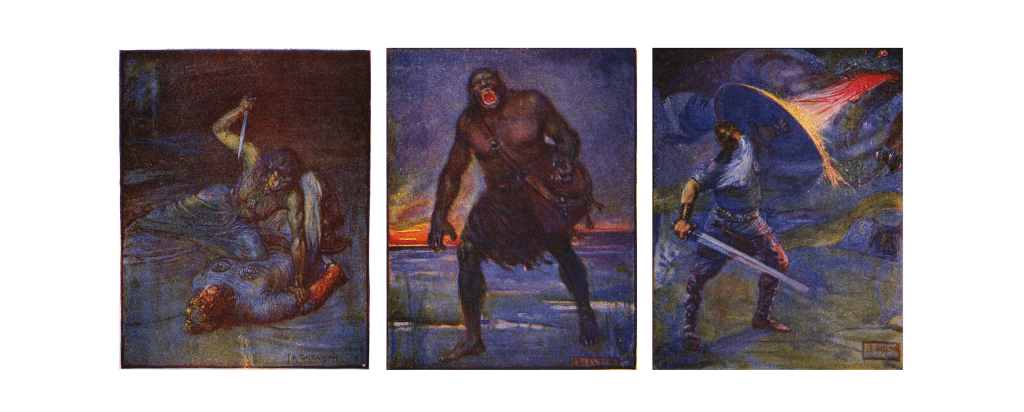
And this one, my favorite, about the ancient giants — the Biblical ones :
Beginning was graven: the gurgling currents,
The flood slew thereafter the race of the giants
Et celui-ci, mon préféré, sur les géants anciens — ceux de la Bible :
Le commencement était gravé : les courants gargouillants,
Le déluge anéantit ensuite la race des géants
“Beowulf” is a key witness to the Germanic heroic code and the fusion of pagan and Christian values; valuable for insights into early medieval Scandinavia. The oldest surviving epic in vernacular English; masterful use of alliteration and oral-formulaic style; profound influence on later literature (e.g., Tolkien).
« Beowulf » est un témoignage essentiel du code héroïque germanique et de la fusion des valeurs païennes et chrétiennes ; il est précieux pour comprendre la Scandinavie du début du Moyen Âge. Il s’agit du plus ancien poème épique en anglais vernaculaire qui ait survécu ; il fait un usage magistral de l’allitération et du style oral formel ; il a profondément influencé la littérature ultérieure (par exemple, Tolkien).
Wonders of the East
Another wonder of the old English literature is the “Wonders of the East”. The book was composed in 1000 AD. As a French reader, I can’t help thinking of Marco Polo and his book “The Book of the Marvels of the World”, co-written around 1300 with the help of a man named Rustichello da Pisa. “Wonders of the East” is deeply similar to books from that period dealing with foreign and distant lands : mystical creatures, long descriptions of wonders, strange imagery… The book is conserved within two manuscripts : the Cotton Tiberius and the Nowell Codex.
Une autre merveille de la littérature anglaise ancienne est « Les Merveilles de l’Orient ». Ce livre a été composé en l’an 1000. En tant que Français, je ne peux m’empêcher de penser à Marco Polo et à son ouvrage « Le Livre des merveilles du monde », coécrit vers 1300 avec l’aide d’un homme nommé Rustichello da Pisa. « Les Merveilles de l’Orient » ressemble beaucoup aux livres publiés à l’époque sur le thème des contrées étrangères et lointaines : créatures mystiques, longues descriptions de merveilles, images étranges… Le livre est conservé dans deux manuscrits : le Cotton Tiberius et le Nowell Codex.
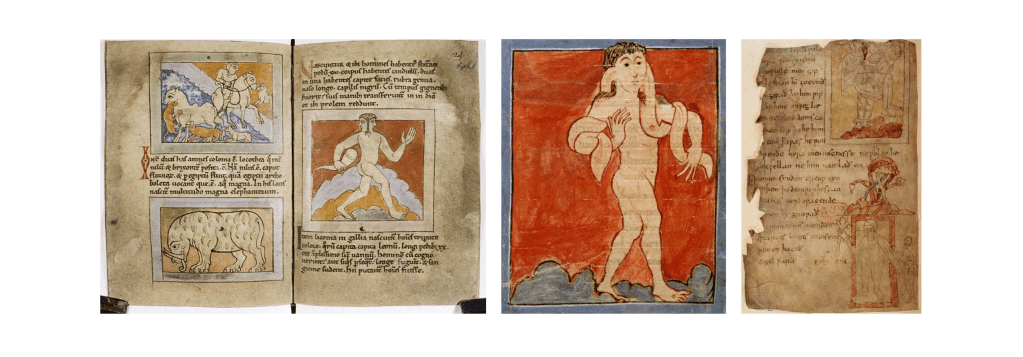
The book covers several regions of the Far-East like Babylonia, Egypt, Persia and India. “Wonders of the East” is full of stories on foreign deities, peoples and creatures. The Nowell Codex contains the Beowulf manuscript. It was translated from a Latin text titled the “De rebus in Oriente mirabilibus”, written in the style of a pseudepigraphal work attributed to Pharasmanes II — King of Iberia. The Latin text was also translated in Old French under the name “Lepistle le roy P[ar]imenis a lempereur”. “Wonders of the East” reveals medieval reception of classical geography and marvels; evidence of textual circulation between Latin and vernacular traditions.
Le livre couvre plusieurs régions d’Extrême-Orient comme la Babylonie, l’Égypte, la Perse et l’Inde. « Les merveilles de l’Orient » regorge d’histoires sur les divinités étrangères, les peuples et aussi les insectes. Le Codex Nowell contient le manuscrit Beowulf. Il a été traduit à partir d’un ancien texte latin intitulé « De rebus in Oriente mirabilibus », écrit dans le style d’un ouvrage pseudépigraphique attribué à Pharasmanes II, roi d’Ibérie. Le texte latin a également été traduit en ancien français sous le nom « Lepistle le roy P[ar]imenis a lempereur ». « Les merveilles de l’Orient » révèle la réception médiévale de la géographie classique et des merveilles ; preuve de la circulation textuelle entre les traditions latine et vernaculaire.
The Canterbury Tales
That’s probably the most famous medieval book of English literature — even in France where it’s read as a classic of British medieval literature. Written by Geoffrey Chaucer around 1400, the book is composed of several tales that can be read independently The whole plot revolves around a group of pilgrims walking from London toward Canterbury.
C’est probablement le livre médiéval le plus célèbre de la littérature anglaise, même en France où il est considéré comme un classique de la littérature médiévale britannique. Écrit par Geoffrey Chaucer vers 1400, le livre est composé de plusieurs contes qui peuvent être lus indépendamment les uns des autres. L’intrigue tourne autour d’un groupe de pèlerins marchant de Londres vers Canterbury.
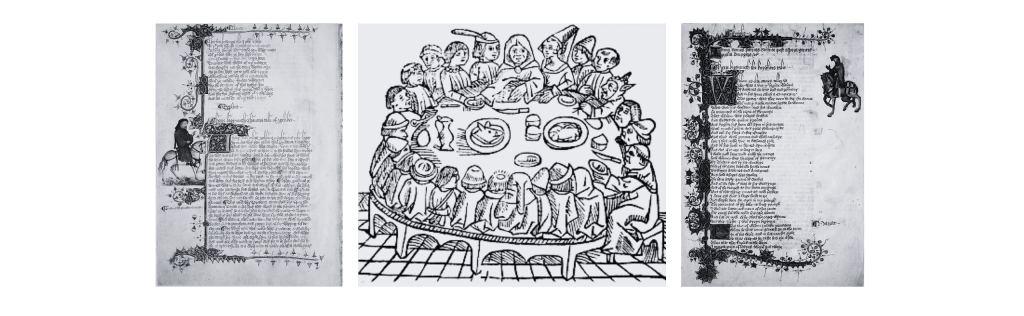
It contains both comic and moral tales. Chaucer also wrote several unfinished works like “The Plowman’s Tale”, “The Tale of Gamelyn”, “Siege of Thebes” and “Tale of Beryn”. A landmark in elevating English as a literary language in the late 14th century; a vivid social panorama of medieval England. “Tales of Canterbury” remains as a remarkable narrative virtuosity and polyphony of voices; a cornerstone of English literary tradition.
Il contient à la fois des contes romantiques et moraux. Chaucer a également écrit plusieurs œuvres inachevées telles que « Le Conte du laboureur », « Le Conte de Gamelyn », « Le Siège de Thèbes » et « Le Conte de Beryn ». Une œuvre marquante qui a contribué à faire de l’anglais une langue littéraire à la fin du XIVe siècle ; un panorama social vivant de l’Angleterre médiévale. « Les Contes de Canterbury » restent un remarquable exemple de virtuosité narrative et de polyphonie des voix ; une pierre angulaire de la tradition littéraire anglaise.
Domesday Book
Written around 1086 under William the Conqueror’s request, it is considered the first census ever made for historical England. The “Domesday Book” was composed to produce a global inventory of England. Scribes went as far as counting every plough in every single village. Contrary to other literary works here, the “Domesday Book” was written in Latin.
Rédigé vers 1086 à la demande de Guillaume le Conquérant, il est considéré comme le premier recensement jamais réalisé dans l’Angleterre historique. L’objectif du « Domesday Book » était de dresser un inventaire global de l’Angleterre. Les scribes sont allés jusqu’à compter chaque charrue dans chaque village. Contrairement à d’autres textes mentionnés ici, le “Domesday Book” est écrit en latin.
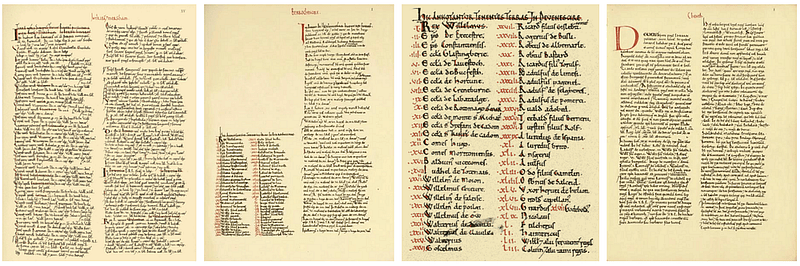
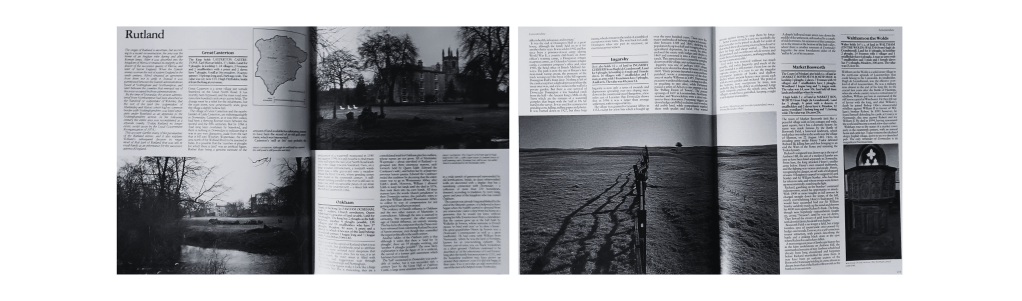
It is considered the earliest surviving state record in England; invaluable for economic, social, and administrative history. Not literary in intent but an emblematic text of administrative writing and royal authority. This would be the sole large-scale survey in country history for centuries before the “Return of Owners Land” in 1873. Several paper editions are published to discover in plain English the “Domesday Book”. My favorite one is “The Domesday Book: England’s Heritage, Then & Now” :
Il est considéré comme le plus ancien registre d’État conservé en Angleterre ; il est d’une valeur inestimable pour l’histoire économique, sociale et administrative. Il n’a pas vocation littéraire, mais constitue un texte emblématique de l’écriture administrative et de l’autorité royale. Il s’agit du seul recensement à grande échelle de l’histoire du pays pendant des siècles avant le « Return of Owners Land » en 1873. Plusieurs éditions papier ont été publiées afin de découvrir le « Domesday Book » dans un anglais simple. Ma préférée est « The Domesday Book: England’s Heritage, Then & Now » :
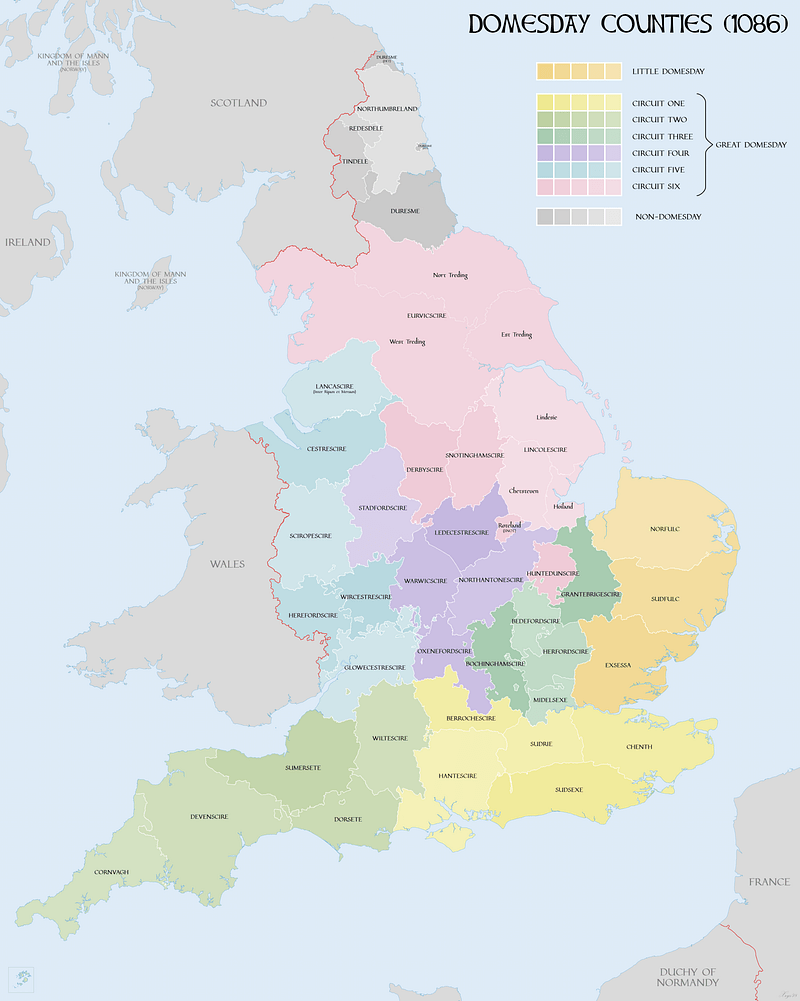
It was a massive undertaking requiring many royal officials To illustrate the extent of the efforts, here is a map illustrating the areas and circuits taken to produce the “Domesday Book” :
La tâche était vaste et nécessitait la mobilisation de nombreux fonctionnaires royaux. Pour illustrer l’ampleur des efforts déployés, voici une carte illustrant les zones et les circuits parcourus pour produire le « Domesday Book » :
Exeter Book
It’s the largest known collection of Old English poetry, elegies, riddles and religious poems — what is described now as an anthology The “Exeter Book” was probably written during the 10th century, and gifted to the Exeter Cathedral in 1072.
Il s’agit de la plus grande collection connue de poésie, d’élégies, d’énigmes et de poèmes religieux en vieil anglais, aujourd’hui considérée comme une anthologie. Le « Livre d’Exeter » a probablement été écrit au Xe siècle et offert à la cathédrale d’Exeter en 1072.
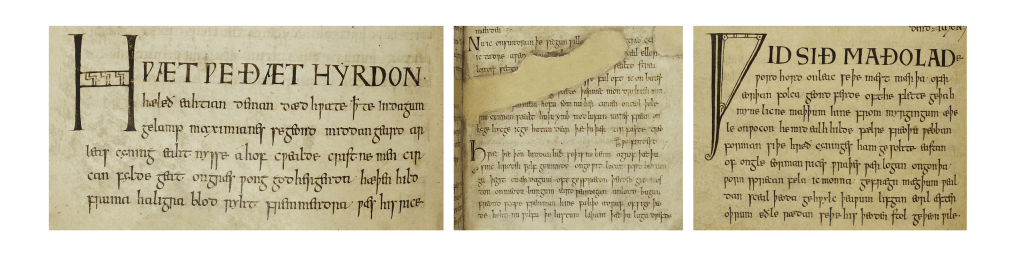
The book is so important that in 2016, UNESCO gave the book the title “Memory of the World” heritage manuscript; a crucial witness to the range of Anglo-Saxon poetic genres, and the foundation volume of English literature, one of the world’s principal cultural artefacts. Several major Old English poems are contained with the “Exeter Book”. The first one is “Widsith”, probably composed around the 7th century. It’s a scop’s song listing kings, peoples, and heroes of the Germanic heroic age. “Widsith” is critical because it allows us to preserve onomastic and geopolitical traditions of late antiquity in northern Europe. It’s an alliterative catalogue poem; reflection on memory, fame, and poetic identity. We can also mention the “Wanderer”. It can be described as an elegy of an exile meditating on the loss of lord and companions, the transience of life, and Christian hope. The poem reflects on the ethos of loyalty (comitatus) and the concept of fate (wyrd). “Wanderer” is considered an elegiac masterpiece of alliterative verse; introspective and philosophical tone.
Ce livre est si important qu’en 2016, l’UNESCO lui a décerné le titre de manuscrit patrimonial « Mémoire du monde » ; il s’agit d’un témoignage essentiel sur la diversité des genres poétiques anglo-saxons et du volume fondateur de la littérature anglaise, l’un des principaux artefacts culturels au monde. Plusieurs poèmes majeurs en vieil anglais sont contenus dans le « Livre d’Exeter ». Le premier est « Widsith », probablement composé vers le VIIe siècle. Il s’agit d’un chant de scald énumérant les rois, les peuples et les héros de l’âge héroïque germanique. « Widsith » est essentiel car il permet de préserver les traditions onomastiques et géopolitiques de la fin de l’Antiquité en Europe du Nord. C’est un poème catalogue allitératif, une réflexion sur la mémoire, la renommée et l’identité poétique. On peut également mentionner « Wanderer ». On peut le décrire comme l’élégie d’un exilé méditant sur la perte de son seigneur et de ses compagnons, la fugacité de la vie et l’espoir chrétien. Le poème réfléchit sur l’éthique de la loyauté (comitatus) et le concept du destin (wyrd). « Wanderer » est considéré comme un chef-d’œuvre élégiaque de la poésie allitérative, au ton introspectif et philosophique.
Anglo-Saxon Chronicle
The Anglo-Saxon Chronicle is an annal of early England history, and more especially the Anglo-Saxons. It covers a period from the 9th century (the book was started under Alfred the Great reign) until 1154. It’s a composite work written by monastic scribes.
La Chronique anglo-saxonne est un annal de l’histoire des débuts de l’Angleterre, et plus particulièrement des Anglo-Saxons. Elle couvre une période allant du IXe siècle (le livre a été commencé sous le règne d’Alfred le Grand) jusqu’en 1154. Il s’agit d’un ouvrage composite rédigé par des scribes monastiques.

The Anglo-Saxon Chronicle is so extensive that the book is now considered as a major source — even primary — to study Anglo-Saxon and early Norman history. The book is written with different styles from prose annals with occasional extended narrative passages; blend of record and storytelling.
La Chronique anglo-saxonne est si complète que cet ouvrage est aujourd’hui considéré comme une source majeure, voire primordiale, pour étudier l’histoire anglo-saxonne et normande primitive. Le livre est rédigé dans différents styles, allant d’annales en prose à des passages narratifs parfois longs, mêlant ainsi chronique et récit.

Caedmon’s Hymn, The Dream of the Rood, The Battle of Maldon, The Seafarer and Lacnunga
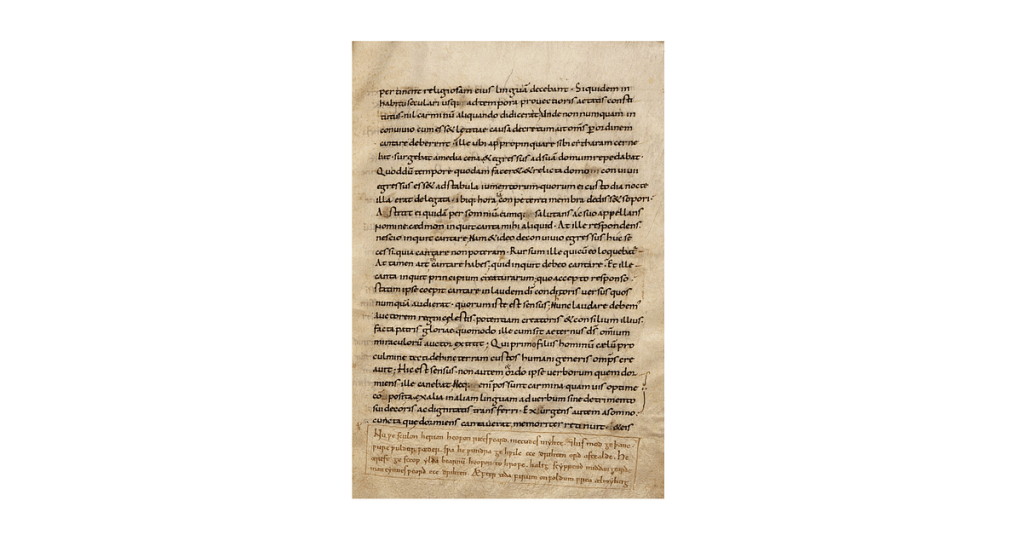
To conclude our overview of Old English literature, a discussion over a few poems. The first one is the “Caedmon’s Hymn”. It was presumably composed between 658 and 680. The poem is attributed to Caedmon, both an historical and mythical figure — according to the legend, he was illiterate, but learnt poetry over the night. The sole account discussing his history is Bede’s Historia Ecclesiastica. “Caedmon’s Hymn” was transmitted in multiple manuscripts of Bede’s Historia Ecclesiastica. Despite its importance, the text is very small. It’s a nine-line hymn praising the Creator, and considered the earliest surviving English poem. The poem is considered as a foundational moment of Christian vernacular poetry in England. From a literary perspective, it’s a model of Old English alliterative verse applied to a hymn; philological importance for its variant forms.
Pour conclure sur la littérature anglaise ancienne, discutons de quelques poèmes. Le premier est l’« Hymne de Caedmon ». Il a probablement été composé entre 658 et 680. Le poème est attribué à Caedmon, personnage à la fois historique et mythique. Selon la légende, il était analphabète, mais aurait appris la poésie en une nuit. Le seul récit évoquant son histoire est l’Historia Ecclesiastica de Bède. « L’hymne de Caedmon » a été transmis dans plusieurs manuscrits de l’Historia Ecclesiastica de Bède. Malgré son importance, le texte est très court. Il s’agit d’un hymne de neuf vers louant le Créateur, considéré comme le plus ancien poème anglais qui nous soit parvenu. Ce poème est considéré comme un moment fondateur de la poésie chrétienne vernaculaire en Angleterre. D’un point de vue littéraire, il s’agit d’un modèle de vers allitératif en vieil anglais appliqué à un hymne ; il revêt une importance philologique en raison de ses formes variantes.
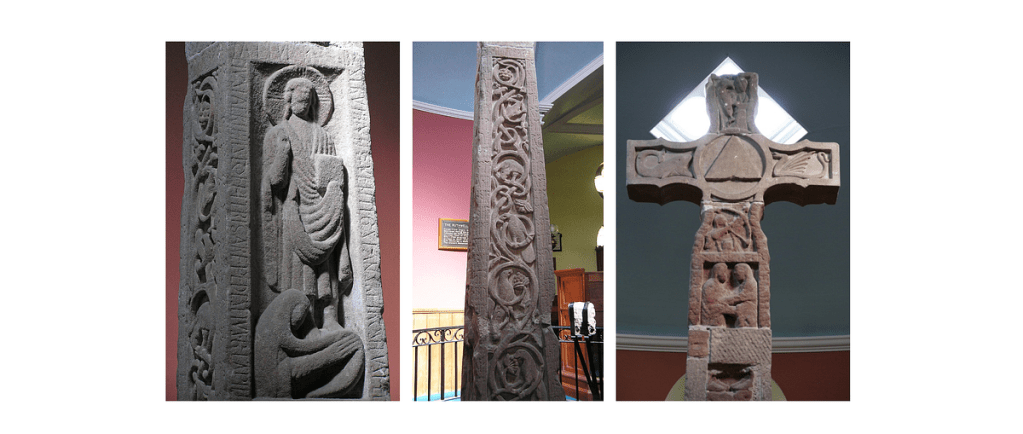
Another significant poem is the “The Dream of the Rood”. It was composed either in the 8th century (related verses were found on the Ruthwell cross) or in the 10th century (it was found in the Vercelli book — one of the four codices of Old English Poetry, the others being the Junius Codex, the Exeter Book and the Nowell Codex). “The Dream of the Rood” could be described as a visionary poem in which the Cross narrates the Crucifixion, blending heroism and suffering. The poem is considered historically significant because it reflects devotional exchanges between Anglo-Saxon England and the Continent. It’s a treasure of Old English literature as a masterpiece of visionary and devotional poetry, and personification of the Cross with heroic imagery.
Un autre poème important est « Le rêve de la croix ». Il a été composé soit au VIIIe siècle (des versets connexes ont été trouvés sur la croix de Ruthwell), soit au Xe siècle (il a été trouvé dans le livre de Vercelli, l’un des quatre codex de l’ancien anglais Petry, les autres étant le codex Junius, le livre d’Exeter et le codex Nowell). « The Dream of the Rood » peut être décrit comme un poème visionnaire dans lequel la Croix raconte la Crucifixion, mêlant héroïsme et souffrance. Ce poème est considéré comme important d’un point de vue historique, car il reflète les échanges dévotionnels entre l’Angleterre anglo-saxonne et le continent. C’est un trésor de la littérature anglo-saxonne, un chef-d’œuvre de poésie visionnaire et dévotionnelle, et une personnification de la Croix avec des images héroïques.
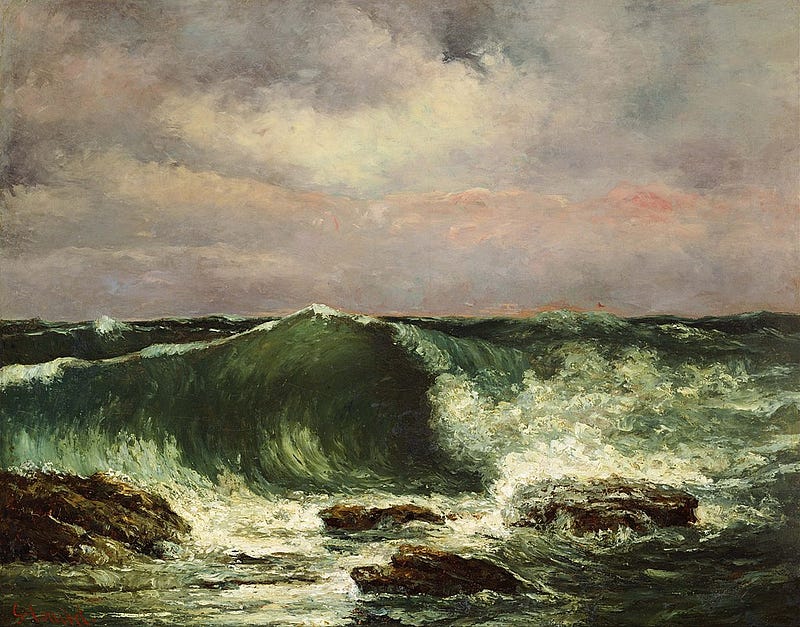
Also extremely important too is “The Seafarer”. Author and composition are uncertain, but the poem was preserved in the “Exeter Book”. It is an elegiac poem voiced by a sailor reflecting on the hardship and solitude of life at sea, the fleeting nature of earthly pleasures, and the yearning for spiritual salvation. The speaker contrasts the harsh physical world with the hope of eternal life, blending themes of exile, fate, and divine faith. From an historical perspective, it provides insight into Anglo-Saxon maritime culture and spiritual worldview; illustrates the synthesis of pagan fatalism (wyrd) with emerging Christian theology and moral reflection.Today, “The Seafarer” is considered as one of the finest Old English elegies, written in alliterative verse; renowned for its vivid imagery of the sea, meditative tone, and complex emotional landscape combining suffering, contemplation, and faith.
« The Seafarer » est également extrêmement important. Son auteur et sa composition sont incertains, mais le poème a été conservé dans le « Livre d’Exeter ». Il s’agit d’un poème élégiaque exprimant les réflexions d’un marin sur les difficultés et la solitude de la vie en mer, la nature éphémère des plaisirs terrestres et le désir ardent de salut spirituel. Le narrateur oppose le monde physique hostile à l’espoir de la vie éternelle, mêlant les thèmes de l’exil, du destin et de la foi divine. D’un point de vue historique, il donne un aperçu de la culture maritime et de la vision spirituelle du monde des Anglo-Saxons ; il illustre la synthèse du fatalisme païen (wyrd) avec la théologie chrétienne émergente et la réflexion morale. Aujourd’hui, « The Seafarer » est considéré comme l’une des plus belles élégies en vieil anglais, écrite en vers allitératifs ; il est réputé pour ses images vivantes de la mer, son ton méditatif et son paysage émotionnel complexe combinant souffrance, contemplation et foi.
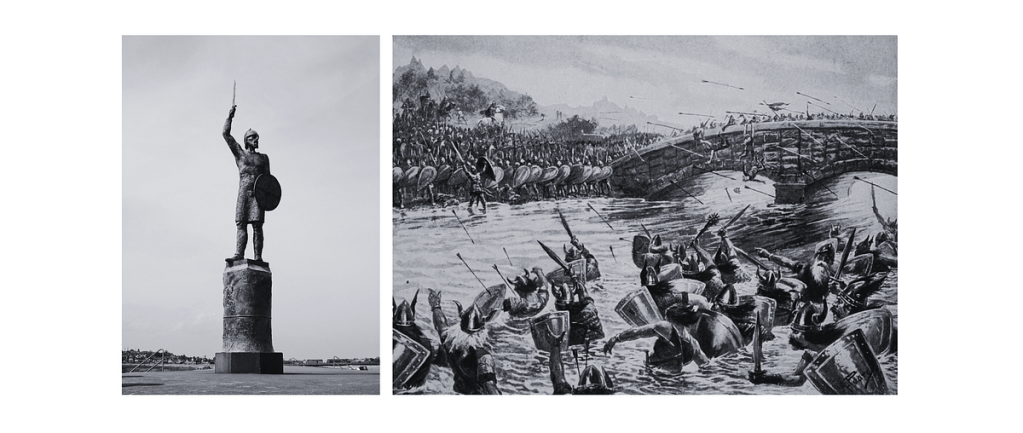
“The Battle of Maldon” is also a major part of Old English literature. The battle of Maldon occurred in 991 between the Vikings and the Anglo-Saxons, and resulted in the Vikings victory. The battle occurred in what is now Essex county. The poem was composed shortly afterward, and what remains is a fragment of 325 lines. It’s a heroic account of the Anglo-Saxon defeat by Viking raiders and the death of ealdorman Byrhtnoth. “The Battle of Maldon” is considered a key document on warrior ethics and late 10th-century political tensions. Several themes are explored within the poem such as loyalty, pride (ofermod), and heroic failure.
« La bataille de Maldon » occupe également une place importante dans la littérature anglo-saxonne. La bataille de Maldon eut lieu en 991 entre les Vikings et les Anglo-Saxons, et se solda par la victoire des Vikings. La bataille se déroula dans ce qui est aujourd’hui le comté d’Essex. Le poème fut composé peu après, et il n’en reste aujourd’hui qu’un fragment de 325 vers. Il s’agit d’un récit héroïque de la défaite des Anglo-Saxons face aux pillards vikings et de la mort de l’ealdorman Byrhtnoth. « La bataille de Maldon » est considérée comme un document clé sur l’éthique guerrière et les tensions politiques de la fin du Xe siècle. Plusieurs thèmes sont explorés dans le poème, tels que la loyauté, la fierté (ofermod) et l’échec héroïque.
And finally “Lacnunga” which was written in the late 10th century and early 11th century. It’s a miscellany of remedies, charms, and prayers in Old English and Latin; related to Bald’s Leechbook. Historically speaking, the poem is considered a major source on Anglo-Saxon healing practices and popular beliefs. The poem is interesting to study regarding poetic charms and the performative power of language (e.g., “Nine Herbs Charm”).
Et enfin « Lacnunga », écrit à la fin du Xe siècle et au début du XIe siècle. Il s’agit d’un recueil de remèdes, de charmes et de prières en vieil anglais et en latin, lié au Bald’s Leechbook. D’un point de vue historique, ce poème est considéré comme une source majeure sur les pratiques de guérison et les croyances populaires anglo-saxonnes. Il est intéressant à étudier en ce qui concerne les charmes poétiques et le pouvoir performatif du langage (par exemple, « Nine Herbs Charm »).

Legacy of Old English literature
Old English literature had a profound and prolonged impact in England. It was with Old English literature that the English language was able to develop and progressively replace Latin, as in other European countries. “Beowulf”, “Seafarer” or “Canterbury Tales”… all these texts contributed to the British national identity. The most influential author to have been influenced by Old English literature is the renowned author J.R.R. Tolkien — well known for his successful series “Lord of the Rings” and also the short novel “The Hobbit”. Old English literature contributed to the constitution of a heroic, poetic and literary identity throughout the ages.
La littérature anglaise ancienne a eu un impact profond et durable en Angleterre. C’est grâce à elle que la langue anglaise a pu se développer et remplacer progressivement le latin, comme dans plusieurs autres pays européens. « Beowulf », « Seafarer » ou « Canterbury Tales »… tous ces textes ont contribué à forger l’identité nationale britannique. L’auteur le plus influent à avoir été influencé par la littérature anglo-saxonne est le célèbre J.R.R. Tolkien, bien connu pour sa série à succès « Le Seigneur des anneaux » et son roman « Le Hobbit ». La littérature anglo-saxonne a contribué à la constitution d’une identité héroïque, poétique et littéraire à travers les âges.
 Simon CHABROL
Laisser un commentaire