In late 80s South Africa, at the height of anti-apartheid protests, a new music genre emerged in South Africa : Township pop or “Bubblegum”. This genre mixed funk, synthesizers, grooves and some typical South African elements — as Zulu songs and dances for examples. It was extremely popular among Black South Africans and most of the singers were Black people — put aside PJ Powers. Some of these singers were well-known outside South Africa like Brenda Fassie or Yvonne Chaka Chaka, but for most of them, notoriety would have remained confined to South Africa. During the late 80s, the South African cultural and musical scene was extremely dense with people like Johnny Clegg, Caiphus Semenya, the Mahotella Queens…
À la fin des années 80, en Afrique du Sud, au plus fort des manifestations contre l’apartheid, un nouveau genre musical a vu le jour : la pop des townships ou « bubblegum ». Ce genre mélangeait le funk, les synthétiseurs, les grooves et certains éléments typiquement sud-africains, comme les chants et les danses zoulous, par exemple. Il était extrêmement populaire parmi les Sud-Africains noirs et la plupart des chanteurs étaient noirs, à l’exception notable de PJ Powers. Certains de ces chanteurs étaient connus en dehors de l’Afrique du Sud, comme Brenda Fassie ou Yvonne Chaka Chaka, mais pour la plupart d’entre eux, leur notoriété restera confinée à l’Afrique du Sud. À la fin des années 80, la scène culturelle et musicale sud-africaine était extrêmement dense, avec des artistes tels que Johnny Clegg, Caiphus Semenya, les Mahotella Queens…
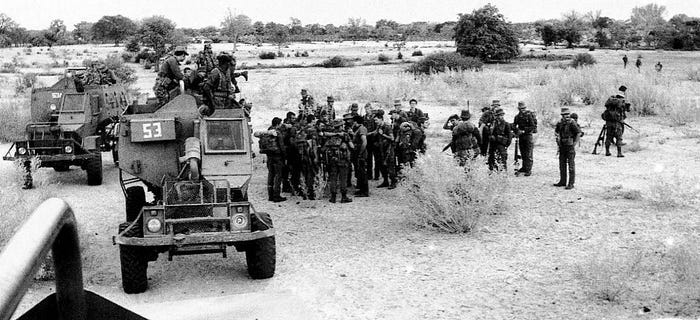
South African Defense Force soldiers in Namibia
Regarding society, Apartheid South Africa was still engaged in a difficult conflict over the control of South-West Africa — today Namibia — and the government was struggling to keep the economy afloat amid internal protests, the Border War and international economic sanctions — at least since the 1960s-1970s. From 1984 to 1989, the country was led by P. W. Botha, an Afrikaner deeply devoted to the survival of the South African unequal regime and opposed to any changes within the South African society.
Sur le plan social, l’Afrique du Sud de l’apartheid était toujours engagée dans un conflit difficile pour le contrôle du Sud-Ouest africain (aujourd’hui la Namibie) et le gouvernement luttait pour maintenir l’économie à flot malgré les protestations internes, la guerre frontalière et les sanctions économiques internationales, au moins depuis les années 1960–1970. De 1984 à 1989, le pays était dirigé par P. W. Botha, un Afrikaner profondément attaché à la survie du régime inégalitaire sud-africain et opposé à tout changement au sein de la société sud-africaine.
Pictures taken in several Bantustans and depicting the poor living conditions : poor soils and makeshift buildings
Nelson Mandela — the main opponent to the Apartheid regime — was still in jail since the Rivona trial in 1964. The African National Congress (ANC) was still banned in South Africa, and acted mainly through its armed branch — the uMkhonto weSizwe. Black people and Coloureds too were largely banned from social, political and economic life by several measures: internal passports, Bantustan areas for Black people, segregation in all places…
Nelson Mandela, principal opposant au régime d’apartheid, était toujours en prison depuis le procès de Rivona en 1964. L’African National Congress (ANC) était toujours interdit en Afrique du Sud et agissait principalement par l’intermédiaire de sa branche armée, l’uMkhonto weSizwe. Les Noirs et les Métis étaient eux aussi largement exclus de la vie sociale, politique et économique par plusieurs mesures : passeports internes, zones bantoustans pour les Noirs, ségrégation dans tous les lieux…
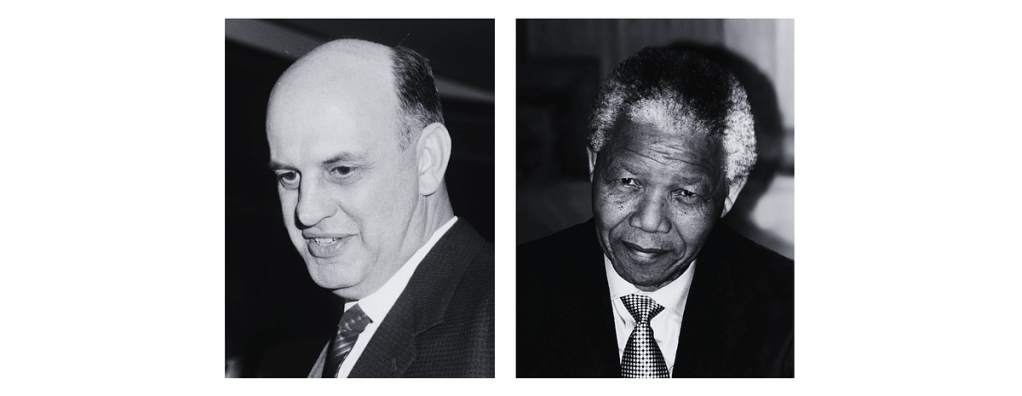
P.W. Botha and Nelson Mandela
At this point, South African society seems at the brink of drastic changes. From this perspective, “Bubblegum” music can be seen as the joyful manifestation of upcoming changes within the country.
À ce stade, la société sud-africaine semble au bord de changements radicaux. Dans cette perspective, la musique « bubblegum » peut être considérée comme la manifestation joyeuse des changements à venir dans le pays.
South African musical terms and styles
South African music is a mosaic of rhythms, languages, and histories. Several terms describe the country’s most distinctive styles. Mbaqanga, sometimes called “township jive,” emerged in the 1960s as a blend of Zulu traditional music, marabi jazz, and American rhythm & blues. Maskandi refers to a style of Zulu folk music characterized by storytelling lyrics, guitar picking, and distinctive vocal harmonies. Bubblegum appeared in the 1980s, mixing disco, funk, and local grooves into a joyful and urban sound that dominated township parties. From the 1990s onward, Kwaito evolved from bubblegum and house music, becoming the voice of post-apartheid youth with its slower tempos and socially conscious lyrics. More recently, Amapiano, a house subgenre with deep basslines and jazz influences, has become South Africa’s leading global export in the 2020s.
La musique sud-africaine est un véritable patchwork de rythmes, de langues et d’histoires. Plusieurs termes désignent ses styles les plus caractéristiques. Le mbaqanga, parfois appelé « township jive », est apparu dans les années 1960 comme un mélange de musique traditionnelle zouloue, de jazz marabi et de rhythm & blues américain. Le maskandi désigne une musique folklorique zouloue fondée sur des textes narratifs, un jeu de guitare particulier et des harmonies vocales expressives. Le bubblegum, né dans les années 1980, fusionne disco, funk et sonorités locales en un son urbain et festif très populaire dans les townships. Dans les années 1990, le kwaito a évolué à partir du bubblegum et de la house, devenant la voix de la jeunesse post-apartheid avec ses tempos plus lents et ses paroles sociales. Plus récemment, l’amapiano, sous-genre de la house aux basses profondes et aux influences jazz, s’est imposé comme la principale exportation musicale sud-africaine des années 2020.
A little bit of History
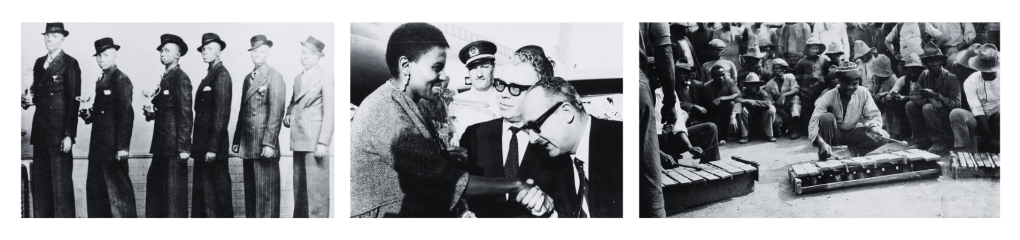
From left to right : Solomon Linda and the Evening Birds (ca. 1941), Zenzile Miriam Makeba in 1963, and African workers at Dutoits Pan Mine (1905)
South Africa has a long cultural history influenced by ethnic and Western influences, and also by the great diversity of its people : Xhosa, Zulu, Afrikaners, Sotho, Indians, Tsonga, Venda… All these influences have played a major role in the growth and development of the South African musical scene. Nearly all genres are represented : gospel, rock, afro-pop, classical music, soul, jazz… Despite the Apartheid and international sanctions, the musical scene continued to incorporate new genres : disco, fusion, electronic music, reggae… The movement continued after 1994 with renewed influences and even the creation of new musical genres as Amapiano or Gqom. Major artists include the Xhosa composer Enoch Sontonga (1813-1905), jazz singer Zenzile Miriam Makeba (1932–2008), Johnny Clegg (1953–2019) known as the “White Zulu”, Rebecca Malope (born in 1968) internationally acclaimed Gospel singer, Laurika Rauch (born 1950) famous for her Afrikaans singing performances…
L’Afrique du Sud possède une longue histoire culturelle influencée par les influences ethniques et occidentales, mais aussi par la grande diversité de sa population : Xhosa, Zoulou, Afrikaners, Sotho, Indiens, Tsonga, Venda… Toutes ces influences ont joué un rôle majeur dans la croissance et le développement de la scène musicale sud-africaine. Presque tous les genres sont représentés : gospel, rock, afro-pop, musique classique, soul, jazz… Malgré l’apartheid et les sanctions internationales, la scène musicale a continué à intégrer de nouveaux genres : disco, fusion, musique électronique, reggae… Le mouvement s’est poursuivi après 1994 avec de nouvelles influences et même la création de nouveaux genres musicaux comme l’Amapiano ou le Gqom. Parmi les artistes majeurs, citons le compositeur xhosa Enoch Sontonga (1813–1905), la chanteuse de jazz Zenzile Miriam Makeba (1932–2008), Johnny Clegg (1953–2019), surnommé le « Zoulou blanc », Rebecca Malope (née en 1968), chanteuse de gospel de renommée internationale, Laurika Rauch (née en 1950), célèbre pour ses interprétations en afrikaans…
Brenda Fassie — “Weekend Special”
Branda Fassie — from her real name Brenda Nokuzola Fassie — born in 1964 and dead in 2004 was an iconic pop singer from South Africa. She was sometimes nicknamed the “Madonna of the Townships”. She was the main singer of the band “Brenda and the Big Dudes”. Her songs evolved from mainstream pop to Kwaito and Afro-Pop in her later albums. Unfortunately, she suffered from cocaine addiction and died from an overdose in 2004.
Branda Fassie, de son vrai nom Brenda Nokuzola Fassie, née en 1964 et décédée en 2004, était une chanteuse pop emblématique d’Afrique du Sud. Elle était parfois surnommée la « Madonna des townships ». Elle était la chanteuse principale du groupe « Brenda and the Big Dudes ». Ses chansons ont évolué de la pop mainstream au kwaito et à l’afro-pop dans ses derniers albums. Malheureusement, elle souffrait d’une addiction à la cocaïne et est décédée d’une overdose en 2004.
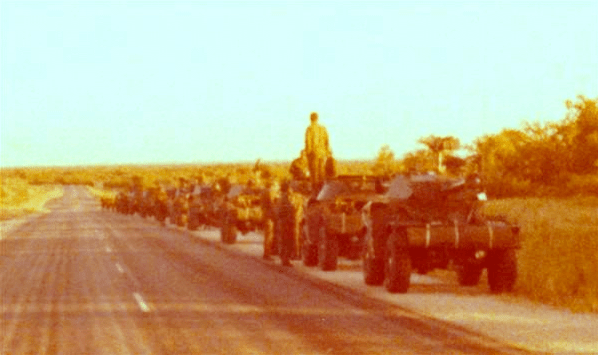
South African Defense Forced launched Operation Askari in Angola in 1983 — here is a convoy of Eland armored cars
Chicco — “We Miss You Manelow”
Well-known for several “hit-singles”, Sello Chicco Twala (his real name) was a producer for several South African artists in the 1980s — including Brenda Fassie and Nkosana Kodi. His song “We Miss You Manelow” — released in 1987 — was written to support Nelson Mandela and protest against the apartheid. Born in 1964, Chicco still lives in South Africa today.
Connu pour plusieurs « tubes », Chicco (de son vrai nom Sello Chicco Twala) était producteur pour plusieurs artistes sud-africains dans les années 1980, notamment Brenda Fassie et Nkosana Kodi. Sa chanson « We Miss You Manelow », sortie en 1987, a été écrite pour soutenir Nelson Mandela et protester contre l’apartheid. Né en 1964, Chicco vit toujours en Afrique du Sud aujourd’hui.
Saul Mkhize in the center of the picture— a human rights activist during the Apartheid fighting for people at Driefontein going to be expelled from their lands — at meeting with the Wakkerstroom Magistrate, Driefontein Mpumalanga, 19 March 1983
Hotline feat PJ Powers — “You’re So Good To Me”
Penelope Jane Dunlop (born in 1960) was one of the few White South African artists — along people like Johnny Clegg — opposed to the Apartheid. She was well-known in the 80s for her pop and funk songs, especially the single “Jabulani”. The apartheid government banned her and several other artists from radio and television in 1988, when she moved to Zimbabwe to give a concert to war orphans. Later in her career, she moved further into Afro-Pop music.
Penelope Jane Dunlop (née en 1960) était l’une des rares artistes sud-africaines blanches, avec Johnny Clegg, à s’être opposée à l’apartheid. Elle était très connue dans les années 80 pour ses chansons pop et funk, en particulier le single « Jabulani ». Le gouvernement de l’apartheid l’a interdite, ainsi que plusieurs autres artistes, à la radio et à la télévision en 1988, lorsqu’elle s’est rendue au Zimbabwe pour donner un concert à des orphelins de guerre. Plus tard dans sa carrière, elle s’est orientée davantage vers la musique afro-pop.
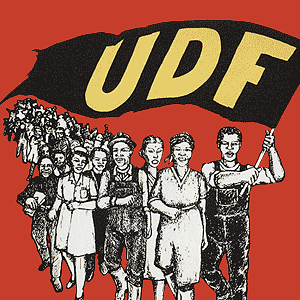
Logotype of the United Democratic Front. It was a South African anti-apartheid political party from 1983 to 1991. Its inaugural chairperson — Peter Mampogoane Nchabeleng — died while under police custody in 1986.
Yvonne Chaka Chaka — “I’m Burning Up”
Yvonne Machaka(born in 1965) was considered at the forefront of the South African musical scene for nearly 35 years. She is credited for several hits in the 80s like “I’m Burning Up”, “Thank You Mr. DJ”, “I Cry For Freedom” and “Motherland”. She also toured worldwide with famous artists like Annie Lenox, Bono or Youssou N’Dour.
Yvonne Machaka (née en 1965) a été considérée comme l’une des figures de proue de la scène musicale sud-africaine pendant près de 35 ans. Elle est à l’origine de plusieurs tubes des années 80, tels que « I’m Burning Up », « Thank You Mr. DJ », « I Cry For Freedom » et « Motherland ». Elle a également fait des tournées mondiales avec des artistes célèbres tels qu’Annie Lenox, Bono ou Youssou N’Dour.
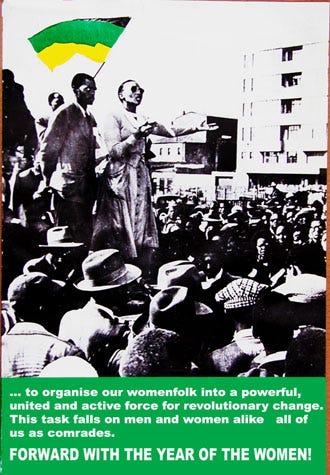
Poster by Thamsanqa Mnyele showing blind trade union leader Viola Hashe speaking at a 1952 “Defiance Campaign” rally in Fordsburg— the poster was designed to commemorate 1984 as “Year of the Women”
Neville Nash — “One of Those Nights”
Neville Nash was one of the smooth voices of the mid-1980s bubblegum scene. His hit “One of Those Nights” combines warm synth lines, soulful vocals, and a laid-back township groove typical of the era. His music reflected the more romantic and mellow side of bubblegum, often played in local clubs and radio shows.
Neville Nash fut l’une des voix suaves de la scène bubblegum du milieu des années 1980. Son tube « One of Those Nights » mêle synthés chaleureux, chant soul et groove détendu typique de l’époque. Sa musique représentait la facette plus romantique et apaisée du « bubblegum », souvent diffusée dans les clubs et à la radio des townships.
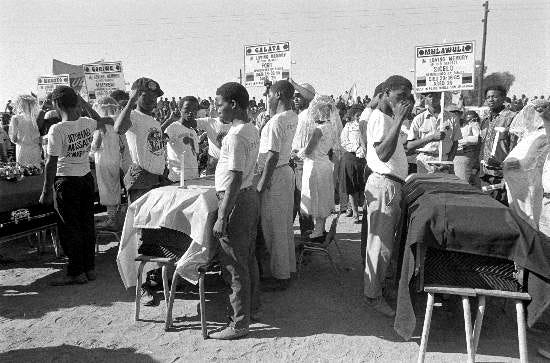
Funeral of the Cradock Four — four anti-Apartheid activists killed by the police — presumably in Cradock on 20 July 1985 (Gille de Vlieg, CC BY 4.0 via Wikimedia Commons)
Steve Kekana — “Raising My Family”
Tebogo Steve Kekana (1958–2012) was famous both inside and outside South Africa for his single “Raising My Family”. He became blind during his childhood. His music genres included Soul, Pop, R&B and also Mbaqanga — a mix of several South African ethnic musics including Zulu, Xhosa, Sotho and Pedhi; mixed too with Western influences as Jazz.
Tebogo Steve Kekana (1958–2012) était célèbre tant en Afrique du Sud qu’à l’étranger pour son single « Raising My Family ». Il est devenu aveugle au cours de son enfance. Il jouait de la soul, de la pop, du R&B et aussi du mbaqanga, un mélange de plusieurs musiques ethniques sud-africaines, notamment zouloue, xhosa, sotho et pedhi, auquel s’ajoutaient des influences occidentales comme le jazz.
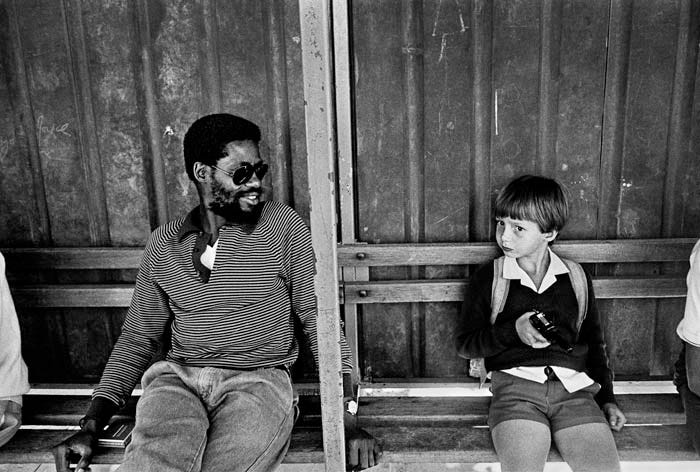
Pietermaritzburg city centre, 1986. Part of the collection from Paul Weinberg that makes up the photographic book Travelling Light and was also part of the Then and Now exhibition at Duke University.
Pat Shange — “Sweet Mama”
Pat Shange (1956–2021) was also deeply appreciated during the 80s “Bubblegum” era. His hit “Sweet Mama” blends vibrant funk basslines, catchy synth melodies, and smooth vocals, creating one of the most recognizable love songs of the era. Unfortunately for the South African musical scene, he died of COVID in 2021.
Pat Shange (1956–2021) était également très apprécié dans les années 80, à l’époque de la « bubblegum ». Son titre « Sweet Mama » combine lignes de basse funk, mélodies synthétiques accrocheuses et chant suave, en faisant l’une des chansons d’amour les plus emblématiques de l’époque. Malheureusement pour la scène musicale Sud-Africaine, il est décédé du COVID en 2021.
Mahlathini and the Mahotella Queens — Gazette
The Mahotella Queens is a three-women band established in 1964 with Nobesuthu Mbadu, Hilda Tloubatla and Mildred Mangxola. The three women are well-known for their traditional and colorful dresses. Their tracks are still appreciated for their happiness — something appreciated by the listeners at the time of anti-Apartheid protests. The three women paired for a long time with baritone Simon “Mahlathini” Nkabinde (1938–1999) well-known for his voice and also his energetic choreography.
Les Mahotella Queens sont un groupe composé de trois femmes, fondé en 1964 par Nobesuthu Mbadu, Hilda Tloubatla et Mildred Mangxola. Les trois femmes sont connues pour leurs robes traditionnelles et colorées. Leurs morceaux sont toujours appréciés pour leur joie de vivre, qualités très appréciées par les auditeurs à l’époque des manifestations contre l’apartheid. Les trois femmes ont longtemps collaboré avec le bariton Simon « Mahlathini » Nkabinde (1938–1999) célèbre pour sa voix et ses chorégraphies énergiques.
The first two South African G6 155-mm howitzers, here demonstrated to the SAAF Senior Command and Staff Course during the winter of 1987 shortly before it first entered service.
Dan Tshanda & Splash — “Peacock”
Splash was a Soweto pop band during the 1980s-1990s. It was formed by Albert Mthimkulu, Daniel Ndivhiseni Tshanda, Joseph Tshimange, Patrick Mthimkulu, Penual Kunene and Peter Leotlela. Many of their tracks are still “classics” as for “Peacock” or “Potilo”.
Splash était un groupe pop de Soweto dans les années 1980–1990. Il a été formé par Albert Mthimkulu, Daniel Ndivhiseni Tshanda, Joseph Tshimange, Patrick Mthimkulu, Penual Kunene et Peter Leotlela. Plusieurs de leurs morceaux sont toujours de grands classiques, comme « Peacock » ou « Potilo ».
General Peter Maringa — “Listen To Me”
General Peter Maringa was part of the late wave of bubblegum artists emerging from Soweto and Johannesburg’s vibrant township scene. His track “Listen To Me” is a quintessential example of the genre’s blend of smooth synths, infectious rhythm, and heartfelt vocals.
General Peter Maringa faisait partie de la dernière vague d’artistes bubblegum issus de la scène foisonnante des townships de Soweto et de Johannesburg. Son morceau « Listen To Me » illustre parfaitement le mélange de synthétiseurs soyeux, de rythmes entraînants et de voix pleines d’émotion typique du genre.
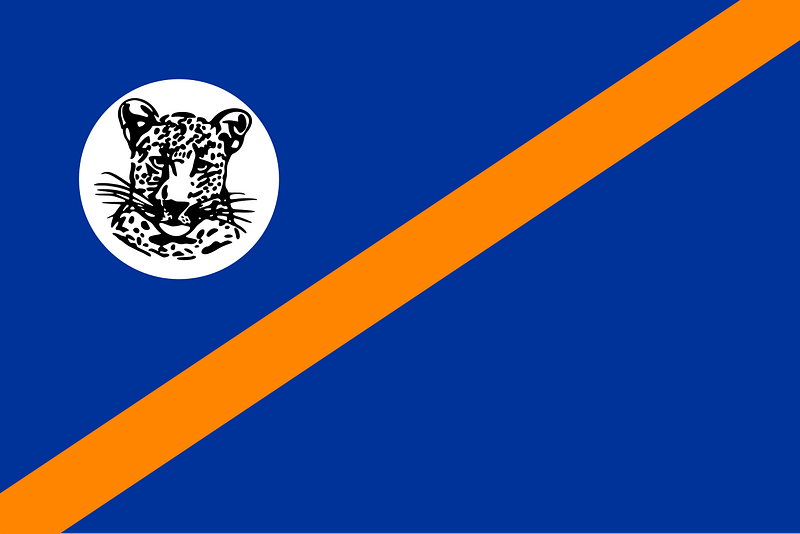
Bophuthatswana’s flag — in 1988, a Coup d’Etat occured in this puppet state of the South Africa, and part of the Bantustan segregated black states. The Coup attempt was crushed by the South African security forces.
Bubblegum Soul & Synth-Boogie in 1980s South Africa
Recently, many major songs of this era were turned into a musical compilation by “Soundway Records” (a British recording label). You can listen to it on Youtube here.
Récemment, de nombreux morceaux phares de cette époque ont été compilés dans un album musical par « Soundway Records » (un label britannique). Vous pouvez l’écouter sur YouTube ici.
You can also buy songs or even the whole compilation on Bandcamp at this adress on Bandcamp.
Vous pouvez également acheter des chansons ou même la compilation complète sur Bandcamp à cette adresse.
To conclude, two tracks I deeply enjoyed while writing this article and doing my searches over “Bubblegum” music. The first “I Need Some Money” made by Chicco — tied to a workplace joke with colleagues a few years ago when we were awaiting pay-checks— and Muzamani by E&S Brothers — a song from an album I deeply appreciated for its rhythmic and electronic sounds. And also a track by Caiphus Semenya : “Matswale” — while not a “bubblegum” song I listen a lot to this South African singer who left South African in the 1960s.
Pour conclure, voici deux morceaux que j’ai beaucoup appréciés pendant que j’écrivais cet article et que je faisais des recherches sur la musique « bubblegum ». Le premier, « I Need Some Money » de Chicco, est lié à une blague entre collègues sur un emploi que j’occupais il y a quelques années quand on attendait la paie, et le second, « Muzamani », du groupe E&S Brothers, une chanson tirée d’un album que j’ai beaucoup aimé pour ses sons rythmiques et électroniques. Et aussi un morceau de Caiphus Semenya : « Matswale » — même si ce n’est pas une chanson « bubblegum », j’écoute souvent ce chanteur sud-africain qui a quitté l’Afrique du Sud dans les années 1960.



 Simon CHABROL
Laisser un commentaire