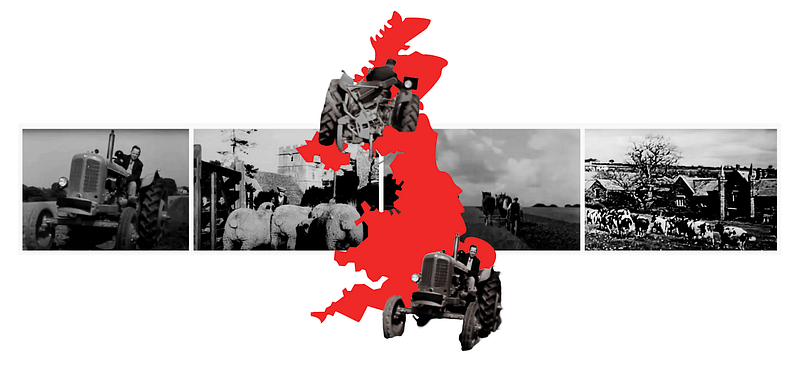
British agriculture faced fast paced changes and increased challenges from the 1930s to the late 1960s. Mechanization, early debates over food production independence, technological progress, promotion of agriculture to the general public… Here are key documentaries from the late 1930s to the 2020s to rediscover the great history of British agriculture from horse-drawn ploughing to mass-mechanization.
- English Harvest (1938)
- The Harvest Shall Come (1942)
- West of England (1951)
- Country Farming: Innovations of the Modern Tractor (1955–1959)
- Running a Family Farm (1957)
- A Year on a Farm by the Sea (1958)
- Hard Life of the Farm Workers (1969)
- Crank Peasant (1975)
- Laxton (1975)
- Six Inches of Soil (2024)
- Miscellaneous
- Conclusions
English Harvest (1938)
— Humphrey Jennings
“English Harvest” can be considered a gem regarding British agricultural documentaries. While a documentary, the movie made by Humphrey Jennings shares a lot of characteristics with romanticism and is an idealization of British rural life. It’s a great depiction of a disappeared world now in the United Kingdom : horse-drawn plowing and harvesting, scythes, steam-powered threshers… It was filmed in August, in Sawston (Cambridgeshire). The location of this documentary in the East of England is interesting. The East of the country was the home of several major and critical agricultural improvements over several centuries, especially regarding crop yields, leading to the British Agricultural Revolution during the 18th century. The most critical innovations were :
- The Norfolk four-course system, invented in Waasland (northern modern Belgium) in the 16th century, but largely improved and popularized by Charles Townshend (Norfolk) in the 18th century with the goal to improve crops rotation/yields
- The improvement of the seed-drill machine by Jethro Tull (Berkshire)
- The implementation of systematic selective breeding by Robert Bakewell (Leicestershire)
- The development of the Southdown sheep through selective breeding by John Ellman (East Sussex)
The progress made in this region was not only technological as British agriculture evolved on many topics with the creation of a nationwide market for agricultural products and improvements in communications/transports. All these improvements proved necessary to sustain the ongoing British industrial revolution. Watching “English Harvest” when you know that the movie was filmed in the agricultural core of England adds interest to this historical piece.
The Harvest Shall Come (1942)
— Max Anderson
The 1942 movie by Max Anderson is considered a masterpiece of communication on the need to assist and revitalize British agriculture. Lasting 33 minutes, “The Harvest Shall Come” depicts rural life from 1900 to WWII. Made during the war, a critical period for the United Kingdom (the country was one of the last European ones not invaded by Nazi Germany, food self sufficiency became a vital national topic. The move revolves around farm workers to support their role in national agriculture.
Food national security became a vital concern during WWI and even more during WWII. Several systems were implemented to improve food production : allotments, Land’s army, Dig for Victory campaign… A less known story regarding the history of the British agricultural system is the allotments system. With the progressive disappearance of the commons, it was important to find a way to allow people to feed themselves both in the countryside but also in growing cities. This was done through the “Allotments and Cottage Gardens Compensation for Crops Act” in 1887. It was necessary in several key urban areas overpopulated and facing huge social challenges among the working classes. The first act proved unsuccessful to implement and faced resistance from local authorities, and was followed by several other acts in 1908 and 1950. These allotments were critical during World War II with the “Dig for Victory” campaign in the United Kingdom to improve food availability for the British people.
It was during WW1 and WW2 that the United Kingdom mobilized a lot of people, notably women with the Women’s Land Army (called sometimes Land Girls) and also soldiers. “The Harvest Shall Come” must be watched carefully, keeping in mind that it’s a propaganda movie, filmed and made in a country deeply concerned by its food self sufficiency.
West of England (1951)
— Greenpark Productions (narration by Laurie Lee)
“West of England” — contrary to other movies here — is not a strictly agricultural documentary. As its name tells it : the movie is focused on the West of England — more especially around the Gloucestershire valley. The movie is celebrated — like “English Harvest” — for its bucolic landscapes, idealization of British rural life and also for its original mix of agricultural depiction and industrial ones. The goal of the movie was to promote both livestock farmers and the industrial production of textile products — Gloucestershire and several western counties were known in the past for clothes production, linked to the historical wool industry in the United Kingdom. The western counties are particularly known for livestock farming in the UK.
In recent times, the British livestock farmers faced several crises. The first being the Bovine Spongiform Encephalopathy (BSE) in the 1980s and 1990s. The second being the foot-and-mouth disease crisis in 2001. Like in many other European countries, milk producers faced plummeting prices despite quotas. In several livestock farming areas, like the Peak District National Park, many farmers have to rely on the Less Favoured Areas subsided to make both ends, and feed themselves and their family. The key three thriving regions in 2023 were the East of England (majority crops farming), East Midlands (major crops farming) and South West (majority livestock farming). All regions behind them –while smaller by size– are either mixed-farming areas (crops and livestock) or majorly livestock farming areas.
The success of the South West region can be explained by several factors : long history of livestock farming, tourism, better soils compared to other livestock farming regions (Wales, Scotland…) allowing for diversification, less dependency on EU agricultural subsidies… For Northern Ireland, the situation is rendered difficult by several past and actual political issues like the disagreements over the border with the Republic of Ireland. To offer a few words regarding British livestock (because the essay is mainly about crops), and while this sector is struggling, this is still an essential part of British agricultural identity. There were a bit more than 9 million cattle in 2024, nearly 5 million pigs, 31 million sheep and 176 million fowls.
Country Farming: Innovations of the Modern Tractor (1955–1959)
— The Nuffield Association in conjunction with Associated British-Pathe Ltd.
This documentary is one of the last before television documentaries on rural life. Made in the late 1950s, it depicts a deeply transformed British agricultural system : tractors, disappearance of horses, reduced workforce… The total opposite of what was depicted in “English Harvest” : an agricultural system moving toward large scale mechanization and industrialization. As indicated by the name, the movie revolves around the improvements made possible by the use of tractors in the British countryside. “Country Farming: Innovations of the Modern Tractor” is precious as it depicts the inevitable shift between past and modern agriculture in the United Kingdom.
Regarding mechanization, the United Kingdom was ahead because the country was considered to have invented the Industrial Revolution. Several companies were manufacturing steam-powered tractors, traction engines and ploughing machines in the United Kingdom (and many of them in Norfolk) : Ransomes, Sims and Jefferies Limited (Norfolk); Charles Burrell & Sons (Norfolk); Aveling and Porter (Kent); Wallis & Steevens (Hampshire); John Fowler & Co. (West Yorkshire)… Since the 1950s-1960s, many efforts have been made to restore/save these old machines in the United Kingdom. Steam fairs have been organised since the 1960s by hobbyists to exhibit these old machines. While popular, many of these events faced rising costs and were progressively cancelled. Like the famous Great Dorset Steam Fair (unfortunately stopped in 2022) or the Grand Henham Steam Rally (liquidated in 2020). Of course, over the decades, steampowered machines have been replaced like everywhere by tractors, sprayers, combine and sugar beet harvesters…
“Country Farming: Innovations of the Modern Tractor” is interesting to watch as the country in the 1950s was moving ahead of mechanization while keeping in mind that while the United Kingdom had a long tradition over agricultural machinery production, their mass use occurs decades later in the field.
Running a Family Farm (1957)
— BBC Archive
This 1957 documentary is interesting for two reasons : it depicts the daily life of a small farming family and the documentary was made in Northern Ireland. This region is generally largely overlooked when we discuss British agriculture — that’s the main reason I decided to add it to the list. The discussion over agriculture in Northern Ireland was complicated in recent years amid the Brexit and dispute over the border with the Republic of Ireland.
A Year on a Farm by the Sea (1958)
— BFI National Archive
“A Year on a Farm by the Sea” made in 1958 depicts agricultural life in South Devon — a British county near Cornwall in South West England. The 20 minute long documentary focuses on children assisting their parents in agricultural and farming tasks — an interesting discovery for people interested in the difficult topic of child labor in the rural world.
Hard Life of the Farm Workers (1969)
— BBC Archive
Made for BBC, this documentary explores the struggle and hardship of British farm workers in the late 1960s. At this time, the life for many of the farm workers was — according to one testimony — near “medievial-level”. Wages were extremely low for many jobs. Many farm workers who were also fathers of families lived below poverty level. The social context was tense. It’s an interesting social documentary to explore the past social challenges of the countryside — sometimes overshadowed by romanticism and idealization.
Crank Peasant (1975)
— John Seymour on self-sufficiency for the BBC
John Seymour (1914–2004) was a well-known British author, especially for his 1976 book “The Complete Book of Self-Sufficiency”. In the United Kingdom, debates over food self-sufficiency have been recurring since the “Corn Laws” abolition in 1846 — these laws were enacted to ban cereal imports in the United Kingdom in 1815. A debate was revived during Brexit too. With his 1976 book, John Seymour brought the debate on the table. This 1975 explores John Seymour’s daily life on his own farm. He discussed the challenges and hopes regarding his dream of self sufficiency.
While marginal, some people in the United Kingdom are (or were) willing to open the debate on food self-sufficiency. The most famous of them being John Seymour, well known for his 1976 book “The Complete Book of Self-Sufficiency”. More recently, Max Cotton (a radio broadcaster) spent one year on his self-sufficient farm in Somerset. Not necessarily related to agricultural self-sufficiency, but important regarding sustainable practices, we can mention Lady Eve Balfour too for her work on organic agriculture. While less “serious”, the British sitcom “The Good Life” (1975–1978) produced by the BBC, was one of the first TV shows to introduce the topic more broadly. Tom Good, bored of his job, decides (with his wife) to become self-sufficient and to grow his own garden in Surbiton (London Suburbs).
Despite all these challenges, British people regularly express their interest in agriculture and their farmers. A survey made by the National Farmers’ Union of England and Wales revealed that :
- 89% of the public feel it is important that Britain has a productive farming industry
- 85% of people support increasing self-sufficiency in UK food production
- 87% of people think it is important that trade deals ensure animal welfare standards are the same in countries we import food from as in the UK
The public interest is also noticeable with the ongoing show “Clarkson’s Farm” where we can follow Jeremy Clarkson (famous hoster of “Top Gear”) on his own farm in West Oxfordshire.
The fact is that the United Kingdom government and other institutions are engaged, in some manner, in a process to develop and improve agricultural production. Many of those efforts remind me of what we see in France to promote products made in France, through several initiatives and also what is called “label d’origine géographique” (or “country of origin mark” in English). Many of them are privately operated, especially those not officials. The first one is the “Assured Food Standards” (known previously as “Red Tractor”) which sought to improve the share of British food in retails (livestock mainly with poultry, beef, lamb, dairy and also several crops). It issues several logos based on how much of the production is done in the UK. “Red Tractor” has operated in the United Kingdom for 25 years, and is still doing so. While praised for its actions, the company was criticized for several issues regarding animal welfare on some labelized farms. We can mention several initiatives like “Love British Food” to promote British food in several places like hospitals and schools. While not directly tied to British-made food, we can discuss the existence of “Landworkers’ Alliance” who promote sustainable practice and the defense of small farmers in the United Kingdom.
To add a few words on Brexit consequences, the British agricultural system is facing numerous challenges threatening its goals for agricultural development. The most important is the difficulty to access the European market for its products since the United Kingdom left the European Union. Another major challenge is tied to the agricultural workforce, as the United Kingdom was employing many immigrant workers.
Laxton (1975)
— BBC
Link : https://player.bfi.org.uk/free/film/watch-laxton-1975-online
In the United Kingdom, the open-field system was how rural lands were organized and exploited before the “Enclosure Acts” between the 16th and 19th centuries. A system dominated by what is called “strip-farming” : a field is cultivated by creating several strips of different crops.
The goal of enclosure was to turn cropland into pasture for sheep and wool production (as a highly profitable industry in the past), and also to improve productivity in several areas when the agricultural system progressively shifted to a more capitalistic and capital intensive system. It occurred mainly between the 16th and 19th centuries, and it was done through local and/or informal agreements at the beginning, and then by “Enclosure acts” made by the Parliaments. Something that affected all of England, allowed for agricultural improvements, but also led to expulsion of many peasants, social unrest in many areas, and migration to cities in several parts of the country. The agricultural landscape of the United Kingdom at this time was similar to the open-field system. Something not to be mistaken with modern agricultural landscape where fields are not physically enclosed, but with an agricultural system where many fields and agricultural tasks were done together.
Laxton — located in Nottinghamshire — is the last village in England to still use the open-field system. This 1975 documentary discusses the topic. In 1975 — and still today — the open-field system in Laxton is still administered through a Court and farmed collectively, like in the past.
Another interesting documentary to watch too is “Mediaeval Village” produced in 1935 and available on the BFI website too :
Link : https://player.bfi.org.uk/free/film/watch-laxton-1975-online
Also, a metaphorical depiction of the enclosures with “Enclosure” (2019) produced by Rachel Rose and available here :
Six Inches of Soil (2024)
— Claire Mackenzie
“Six Inches of Soil” is an interesting documentary about agroecology. The documentary discussed how farmers across the United Kingdom are improving the way they produce food to both guarantee food self sufficiency and also protect the soils. Three farmers from three counties — Cambridgeshire, Lincolnshire and Cornwall — discuss their practices and challenges regarding food production and soil preservation/regeneration.
Miscellaneous
— “God Speed The Plough”! Aka Good Speed The Plough (1932), Farm Automation (1957), Science and the Farmer (1959)…
To conclude, several short movies generally produced for “newsreel” in cinema are available from the Pathe’s archives. Ploughing championship, science promotion in agriculture, educational farms for destitute, horse-drawn ploughing… Short but amazing small fragments of forgotten British agriculture past — “East Anglian Harvests” and “Agriculture’s Royal Show” are my favorites.
Conclusions
With these ten documentaries, anyone can understand the history, challenges and future of British agriculture from the late 1930s to modern times. Like everywhere, the British agricultural system evolved quickly in a few decades. These documentaries cover nearly all topics to understand the British agricultural system : pre-war agricultural life, social struggle, ecological challenges, self-sufficiency debates and even historical oddities like the Laxton village.
 Simon CHABROL
Laisser un commentaire