
The 1984 movie Threads (BBC) made by Mick Jackson depicts the consequences of a fictional nuclear war in the United Kingdom. Last year, I published three essays on this movie. You can find them here :
- UK 1984–1985: analysis of the fuel crisis and societal collapse in Threads (1984) : a reconstruction of the events of the first year in the film leading up to a major societal collapse
- UK 1985–1994: explaining the narrative jump in Threads (1984) : an attempt to reconstruct the decade between the scenes at the end of the first year, which describe total chaos, and the scenes ten years later, which show a country that has regained the necessary stability
- Some deep thoughts on Threads (1984) : a summary of the previous two articles, and more general thoughts on the problematic aspects of the film (and more generally, films and scientific studies on this subject) from a moral and ethical point of view.
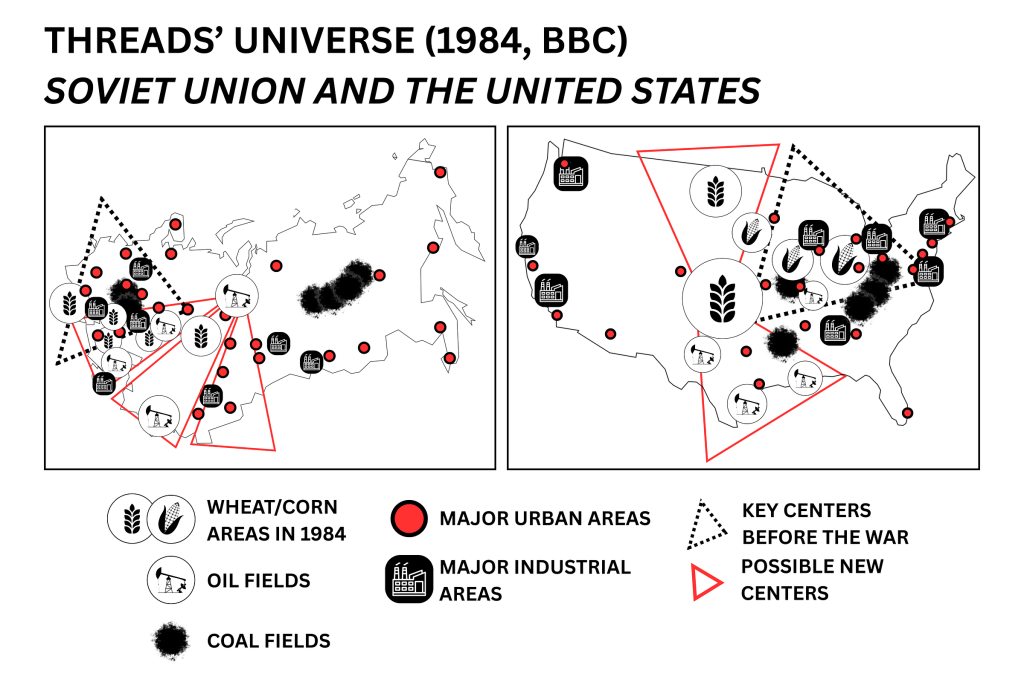
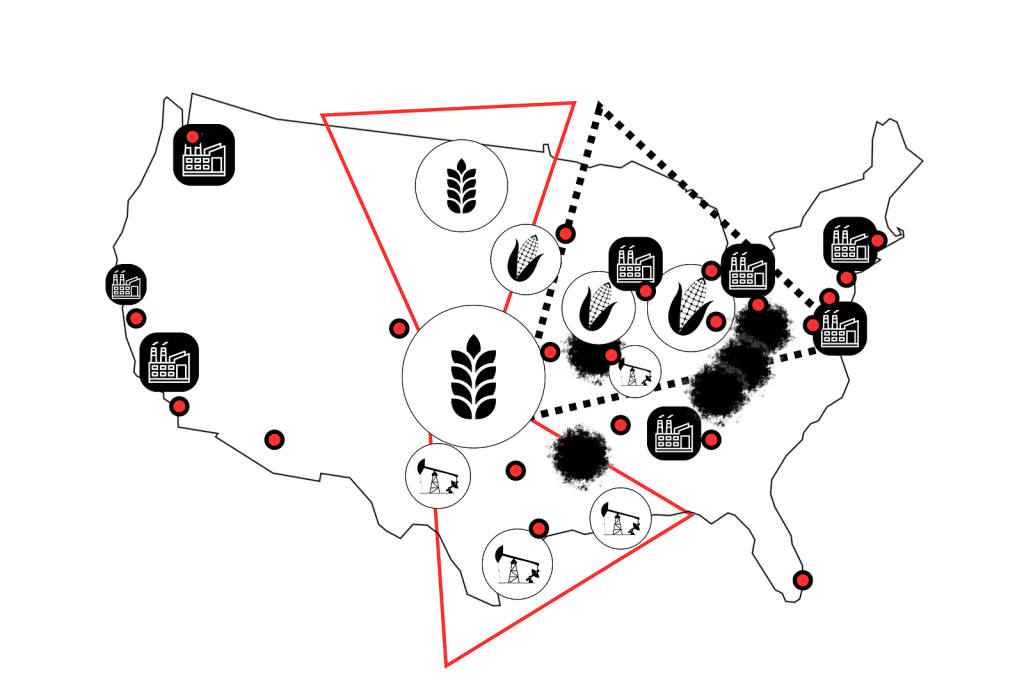
This very brief article is made to discuss the fate of the Soviet Union and the United States in the movie’s universe. Both countries are the main belligerents in the movie’s universe, yet their fate remains unknown and subject to offscreen speculation. This short article explores a question deliberately left unanswered by the film: what happened to the two main belligerents of this conflict — the Soviet Union and the United States? To summarize the possible outcome of these two countries, here is the following map :
- Recovery
- Concerns
- Industry, agriculture and governance
- Focus on the Soviet Union
- Focus on the United States
Recovery
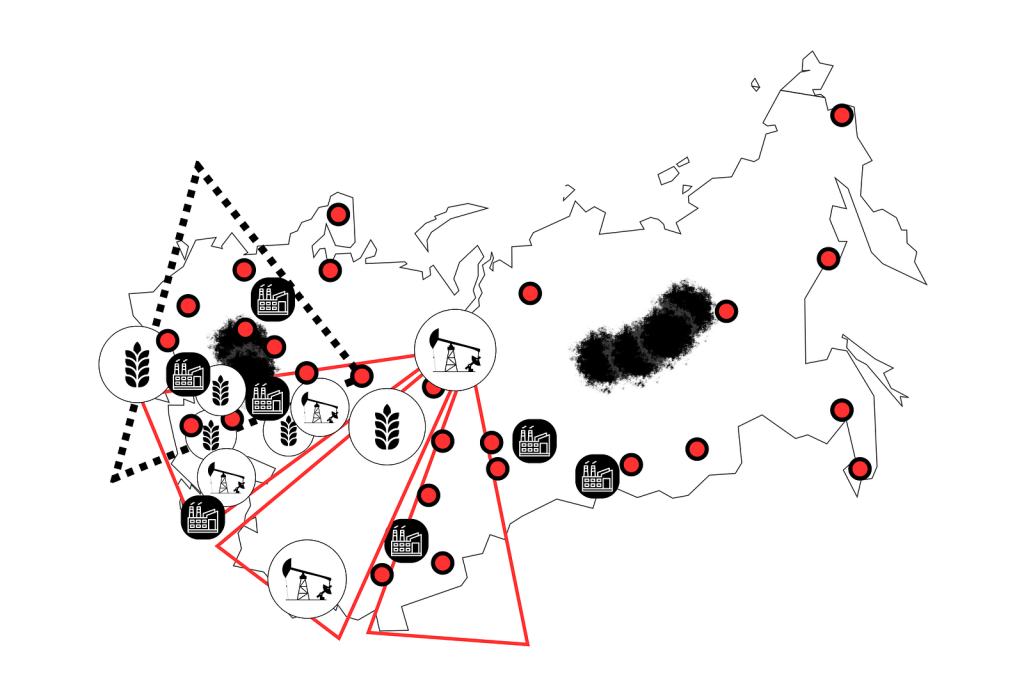
The idea, like in the essays trilogy, was to identify the most plausible solution for both countries. As you can notice : the key economic centers would have been largely targeted by nuclear weapons — West of the Soviet Union around Moscow, and the North-East coast of the United States. The goal was to find the most logical zones where recovery could be organized. Crossing agricultural, soil, mining and industrial maps; two likely solutions likely for the Soviet Union and the United States.
For the Soviet Union, the most logical redevelopment should occur in the South of the country around Southern Ukraine, Caucasus and Southern areas around the Ural mountains. That’s where grain crops areas, industrial capabilities and resources are available.
For the United States, the most logical solution seems to be along the Western plains to the South-East of the country to mix grains growing areas, remaining industrial capabilities, oil and also coal.
From the map drawn, the Soviet Union seems more advantaged than the United States, because the intersection between food, industries and resources is far more clearer than in the United States. Of course, this does not imply prosperity or stability — only that basic recovery might be more achievable there.
Concerns
The main concerns for both countries, like for the United Kingdom in my previous essays, is the pursuit of national governance and how to keep national solidarity and cohesion. While the United States were more integrated socially and ethnically than the Soviet Union, both countries could have faced serious social challenges following the nuclear war.
The topic of nationalities was extremely sensitive in the Soviet Union, especially in Caucasus and Central Asia regions — regions identified by the map as possible recovery areas because they could have been spared during the nuclear exchange and are tied to grain growing areas.
Another question is how to maintain national cohesion over such large territories. Contrary to the United Kingdom, the Soviet Union and the United States are very large countries. While this is not the goal of this article, a dangerous fragmentation is more likely to occur in both countries given their size, long distances, the scale of the attack and the nationalities issues especially in the Soviet Union. These countries also had large populations. In 1984, more than 250 million people lived in the Soviet Union, and more than 230 million in the United States. It could both have been seen as a major difficulty (how to feed and organize so many people ?) and an opportunity (more surviving people to organize the recovery).
Industry, agriculture and governance
In the 1980s, there were also major economic concerns in the United States as deindustrialization was underway — a concern similar to the 1980s United Kingdom. On this topic, the USSR was a bit more protected given the scale of the industrial complex — even if unproductive in several fields. Could the United States have a more resilient economic system than the Soviet Union ? That’s difficult to assess, but at least, it could be said that the United States was not dealing with chronic shortages, massive absenteeism or large-scale economic inefficiency. Another topic was the level of self-reliance of each country. The Soviet Union, again, had a large industry able to cover many of its needs without relying on imports. The United States was already engaged in more and more outsourcing of its industrial production, especially in Mexico.
At the time of the movie (1984) the United States and the Soviet Union were producing a similar amount of grains (200 million tons) but the Soviet Union was constantly importing grains to satisfy its internal demand and in face of logistical struggles — especially because of population difference between the two countries.
What kind of governance could have emerged following the nuclear exchange ? In the Treads movie analysis, it was posited that at one point the national civilian government could be replaced by a mix of military, technicians, farmers and civil servants following the collapse of the rationing program depicted in the movie. The Soviet Union was already largely militarized at the time, not only because of its large armed forces, but also with several corps like the KGB, internal security services, border guards or police forces. It was also an authoritarian state at the time. The United States had no experiences of dictatorship or militarized government in its history. One concern could have been the availability of firearms in several States of the country. A typical factor of instability, factionalism and violence following a major and disruptive event. As a matter of fact, in 1984, 47% of adults in the United States lived in households with one gun. And 25% of the Americans in 1984 had a gun permit.
Focus on the Soviet Union
Key numbers in 1984 :
- Population: ~271 million
- Land area: ~22.4 million km²
- GDP (nominal): ~$2.2 trillion
- GDP per capita: ~$8,200
- GDP growth: ~2%
- Active military personnel: ~5.3 million
- Defense spending: ~16% of GDP
- Nuclear warheads: ~39,000
- Oil production: ~12 million barrels/day
- Life expectancy: ~68 years
In 1984 the Soviet Union was a global superpower at its territorial and military peak, but internally strained. It had a vast population of around 270 million and the world’s largest land area, with an economy based on central planning that ensured full employment and universal education but suffered from low productivity, technological lag, and chronic shortages of consumer goods. Heavy industry, energy production, and the military dominated economic priorities, with defense absorbing a very large share of national resources. Politically, power was concentrated in the Communist Party during a period of leadership stagnation under Konstantin Chernenko, while the war in Afghanistan, falling efficiency, and declining growth signaled deep structural problems despite outward strength.
As explained before, the main economic and political centers of the Soviet Union were located in the West around Moscow, Leningrad and the Western republics (Ukraine, Belarus, Baltic states). It was a largely self-sufficient country at the time with a large industry, mineral resources, a big population and large amount of arable lands. One interesting fact : despite its industrial focus, the country was not as much urbanized, with only 66% of its population living in cities. The Soviet Union had 230 million hectares of arable lands in 1984 — far more than the United States — but it was inefficient given the lack of mechanization and poor management of collective farms.
The yields in the Soviet Union were relatively low compared to modern standards at the time — for grains it was around 2 tons/hectare. If we took the same figures I used for my analysis on the United Kingdom in Threads’s movie universe regarding deaths following the nuclear attack (between 35% and 50% of the population) it could leave an average of 155 million people in the Soviet Union. With extremely low yields for grains (1 ton/hectare) and a high loss-rate (seeds, spoilage, livestock) it would require approximately 85 million hectares to feed the remaining survivors. It represents approximately 548 kg/year, or 274 kg/year after reducing losses. Or 750 grams per day. It could be largely insufficient if these grains are solely corn. In “cooked-form”, corn calories per 100 grams is approximately 100, when it’s 300 for backed wheat.
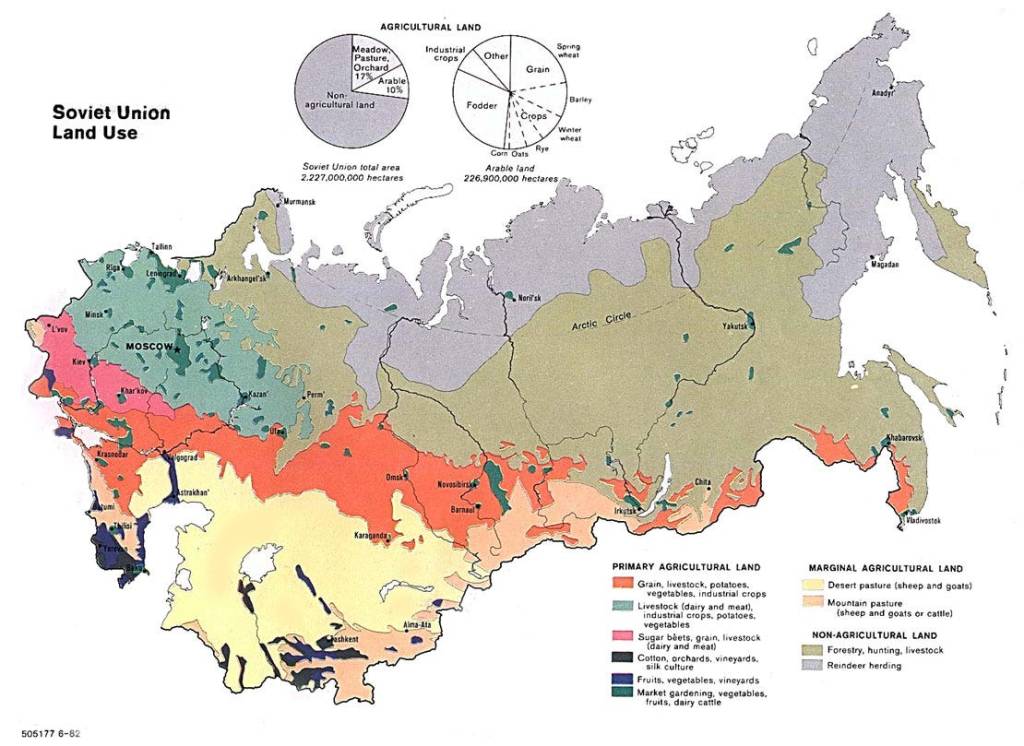
An interesting point : cotton. Both the Soviet Union and the United States were producers at the time. A key advantage regarding textile production following a nuclear war — something the United Kingdom in the movie universe can’t afford. The 1982 CIA maps below confirms the identification of the Southern regions of Ukraine and Russia, along with Caucasus as possible recovery areas for the country :
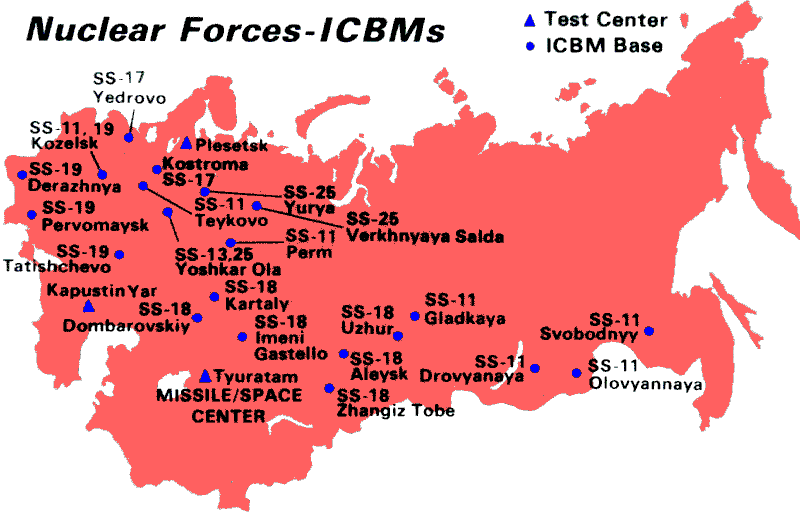
This 1980s map of ICBMs bases in the Soviet Union confirms too the extreme vulnerability of the West following a massive nuclear attack given the concentration of targets : military bases, ICBMs launch sites, key cities (Moscow and Leningrad), industries…
What kind of future holds for the people of the Soviet Union ? Given the information listed above, we can infer several social, economic and political paths for the Soviet Union. Like any country following such a disaster, the focus on agricultural production is not debated — “a matter of life and death” to quote the voice narrator in Threads. The main advantages of the Soviet Union at the time were its verticality, large rural population and culture of obedience. Given its smallest rate of urbanization at the time, the country could have been a bit less concerned by city reconstruction and have focused more quickly on the redevelopment of its agricultural base.
The clear disadvantages of the Soviet Union were its crumbling economy and large-scale inefficiency. How to recover properly when the system is already in serious troubles in normal conditions ? That’s a difficult question to answer. Central planning systems are not guaranteed to develop quickly the flexibility required to handle a major crisis across an entire country, even if centralization and large-scale planning culture is an asset following a major disaster. Given the great size of the country, the question of the peripheral regions and republics also arises. Could the Siberian regions still be managed centrally ? What about extremely remote areas like Vladivostok ? How to organize national solidarity given the extreme population density contrasts across the Soviet Union ? After the hypothetical war, the recovery path of the Soviet Union seems to be extremely tied to its ability to quickly adapt rigid systems on all terms — agriculture, political and social — the material aspect of the recovery being less important than the structural issues of the Soviet Union at the time.
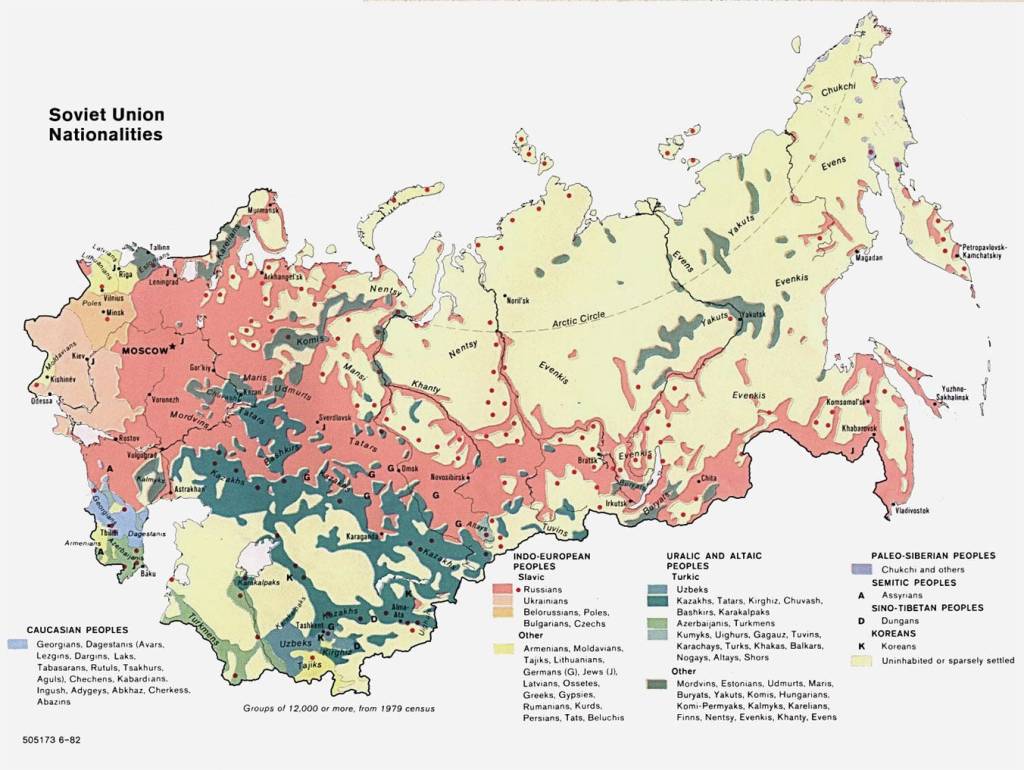
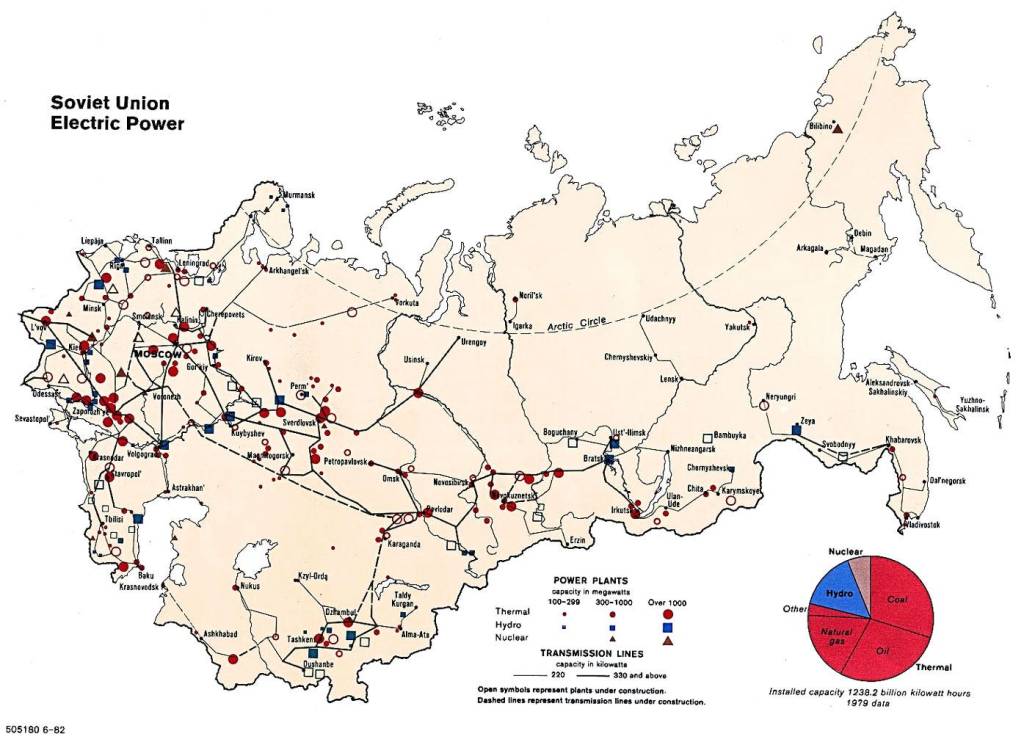
The concern with nationalities is perfectly illustrated with this map. Ethnic Russians (the majority of Soviet Union population in 1989 amounting for 51% of the total population) were largely concentrated in the Western regions of the Soviet Union. The Southern regions of the Soviet Union were largely populated with ethnic Ukrainians, Caucasians and Turkic people. A post-nuclear Soviet Union would have been logically less governed by ethnic Russians given the possible better outcomes of the Southern Regions. On another topic : energy. The Soviet Union had many nuclear, conventional and hydro power stations. Many of the hydro power stations were concentrated in the South region of the Soviet Union as illustrated with this map :
Focus on the United States
Key numbers in 1984 :
- Population: ~236 million
- Land area: ~9.8 million km²
- GDP (nominal): ~$4.6 trillion
- GDP per capita: ~$19,500
- GDP growth: ~7%
- Active military personnel: ~2.1 million
- Defense spending: ~6.5% of GDP
- Nuclear warheads: ~23,000
- Oil production: ~8.7 million barrels/day
- Life expectancy: ~75 years
In 1984 the United States was emerging strongly from the early-1980s recession and reaffirming its leadership in the Western world. With a smaller population but a much larger and more dynamic economy than the USSR, it enjoyed high productivity, rapid growth, and rising consumer prosperity driven by market capitalism, technological innovation, and financial expansion. Under President Ronald Reagan, the country pursued tax cuts, deregulation, and a major military buildup aimed at confronting Soviet power, while also experiencing growing budget deficits and social inequality. Culturally influential and technologically advanced, the United States entered the mid-1980s with confidence and momentum in the Cold War.
As explained earlier, the key economic, political and agricultural centers were on the East coast and around the Great Lakes region. It was relatively self-sufficient too like the Soviet Union in 1984 with an highly efficient agricultural system and large mineral resources. It was far more urbanized than the Soviet Union with more than 70% of its population living in cities at the time. It had less arable lands than the Soviet Union (185 million hectares compared to 230 million for the Soviet Union) but it was largely outpassing the Soviet Union’s performance in this field — thanks to private sector initiative, mechanization and agro-chemicals.
The American yields for grains were relatively high compared to international standards — 5–6 tons/hectare for corn/wheat in 1984. If we took the same figures I used for my analysis on the United Kingdom in Threads’s movie universe regarding deaths following the nuclear attack (between 35% and 50% of the population) it could leave an average of 135 million people in the United States. With extremely low yields for grains (1 ton/hectare) and a high loss-rate (seeds, spoilage, livestock) it would require approximately 74 million hectares to feed the remaining survivors. It represents 548 kg/year, or 274 kg/year after reducing losses. Or 750 grams per day. It could be largely insufficient if these grains are solely corn. In “cooked-form”, corn calories per 100 grams is approximately 100, when it’s 300 for backed wheat.
As stated for the Soviet Union : cotton. Both countries were producers at the time. A key advantage regarding textile production following a nuclear war — something the United Kingdom in the movie universe can’t afford. The following map is interesting given the identification of the Western regions for recovery (the map was made by the FEMA in the 1980s) :
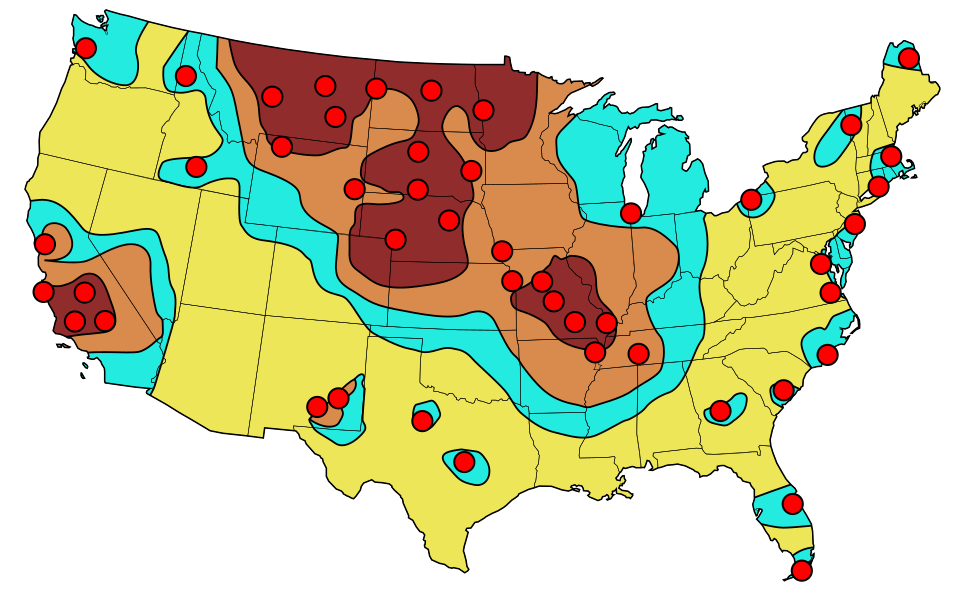
The regions identified in the map for recovery could have been heavily targeted by nuclear weapons during a massive exchange. The FEMA map lets us think that the East could be less impacted by nuclear bombings. That’s why it was important to cross this map with wheat and corn growing maps to assess the situation more clearly :
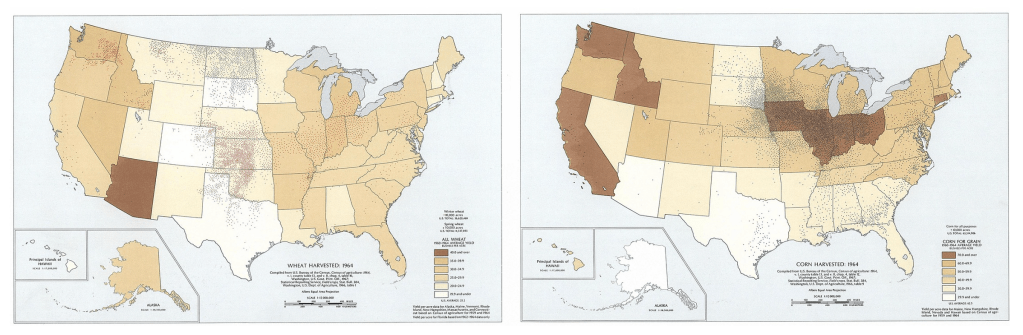
These two maps from 1964 clearly depict that most of the wheat and corn growing areas in the United States were precisely located in these areas identified for recovery. It means that even if radiation hazard was a major issue : the geographical configuration of the agricultural system in the United States made concentration of the recovery efforts mandatory in these areas.
What kind of future holds for the people of the United States ? Given the information listed above, we can infer several social, economic, and political paths for the United States. As with any country facing such a disaster, the priority given to agricultural production would hardly be debated — “a matter of life and death,” to quote the voice narrator in Threads. In the American case, the main strengths would lie in a highly productive and mechanized agricultural sector, vast arable lands, and a long tradition of logistical efficiency and private initiative. The diversity of climates and regions could allow some areas to resume food production more quickly than others, potentially creating regional poles of recovery. However, the high level of urbanization and the concentration of population in large metropolitan areas would make the reconstruction of cities and critical infrastructure an unavoidable priority from the outset.
The clear disadvantages of the United States would stem from its deep dependence on complex supply chains, advanced technology, and a service-oriented economy. How to recover properly when agriculture, energy, transportation, and finance are so tightly interlinked? This is a difficult question to answer. A decentralized federal system and a market-based economy can encourage local adaptability and innovation, but they also risk fragmentation and unequal recovery between states and regions. Coordinating a nationwide response across a continent-sized country would be a major challenge. What role would the federal government play compared to state and local authorities? How would national solidarity be organized in a country marked by sharp economic inequalities and strong regional identities? In such a context, the American recovery would likely be uneven, shaped as much by political cohesion and institutional cooperation as by material resources alone.
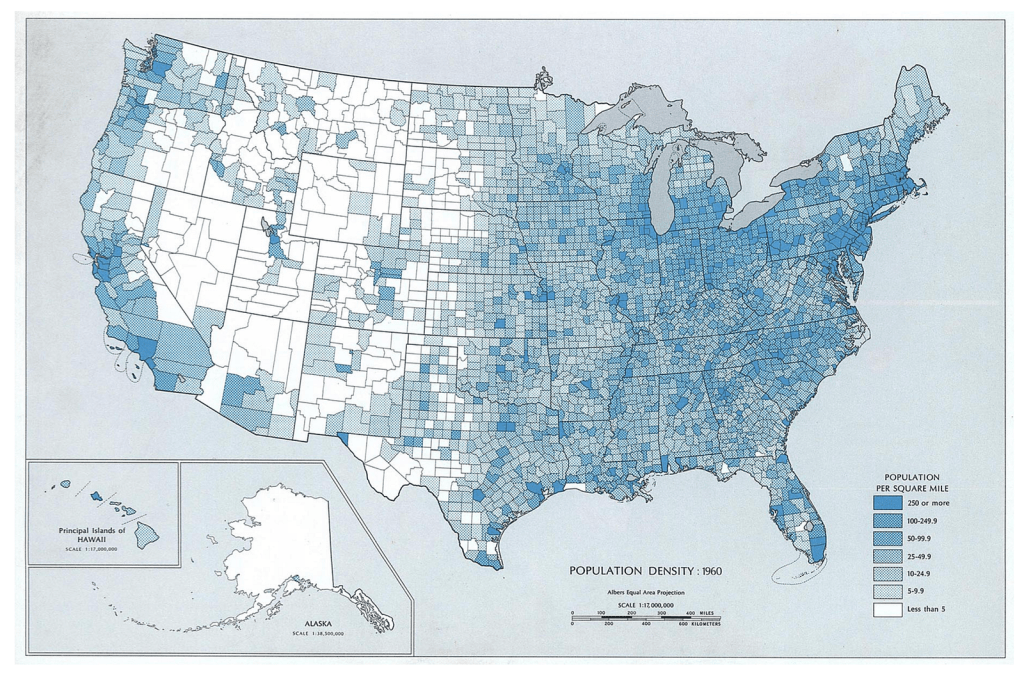
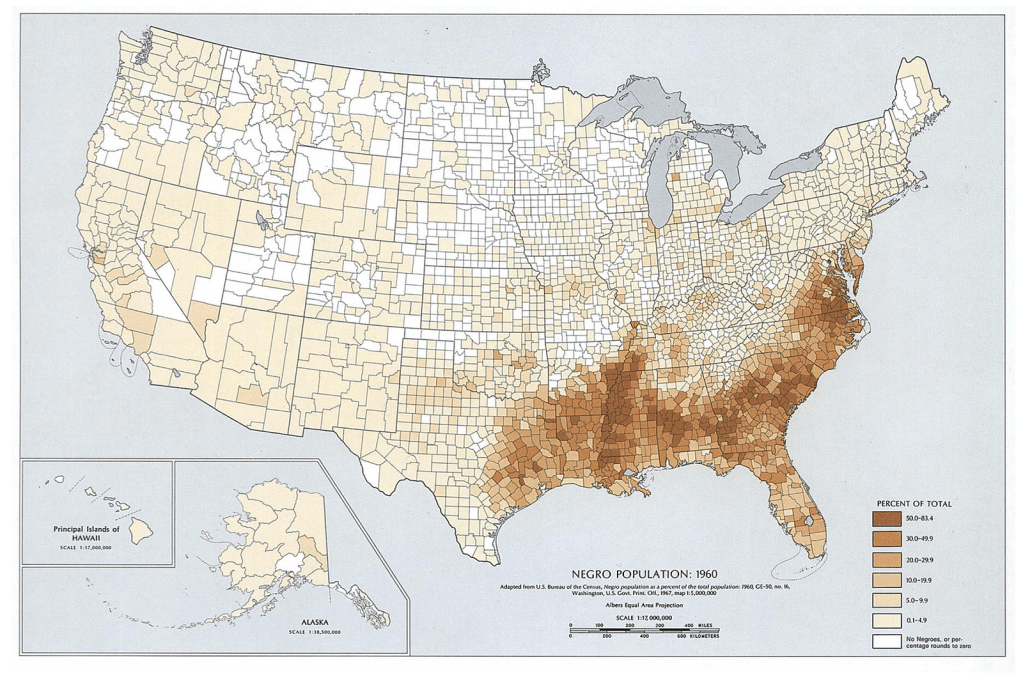
The density map above from the 1960s is interesting. While the density has decreased a little bit (especially through internal migration like with the Black people exodus from the Black Belt following mechanization of cotton industry in the Southern States) the fact remains that in the 1980s a large fraction of the Western States and counties had extremely low population densities. A possible factor of disunion is maintaining the ties between the concentrated West coast areas, the large under-populated Western areas and the Eastern/Southern States of the country could be prohibitive (long distances, lack of fuel, difficult communication…). Regarding the ethnic divide of the United States, an interesting topic is the Black Belt. Because this area from the Texas to the Virginia’s coasts could be less impacted following a nuclear war, it could be a logical part of a recovery area. In the American context, it raises how past and present issues regarding the Black or African-American people could have been properly handled following such a disaster.
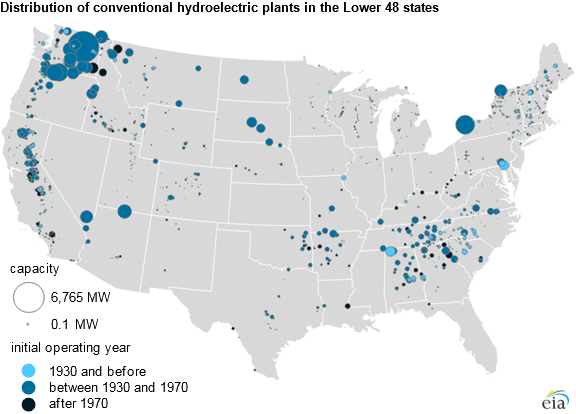
And like for the Soviet Union, here is a map regarding hydroelectric power plants. Interestingly, most of the dams are concentrated in regions far away from key agriculture areas identified on the first map for the United States. Most of them are in the North-West of the country around Seattle, in California, around the Great Lakes near the East coast and in the Southern States. While not implausible, it seriously complicates the possibility of “easy” electric power generation following a massive nuclear exchange.
The maps used for this article come from the Perry-Castañeda Library Map Collection (University of Texas).
 Simon CHABROL
Laisser un commentaire