
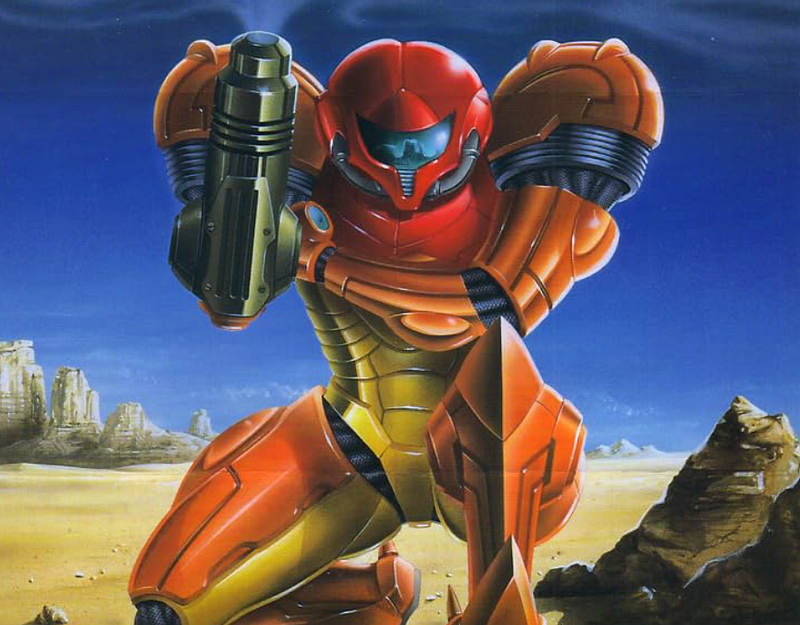
Released in 1991–1992 and despite the good contemporary reviews, Metroid 2 is largely overshadowed today by many fans of the Metroid franchise. And perhaps for a good reason : its successor Super Metroid. The third installment of the franchise is well remembered and still played today for its incredible story-telling, action, bosses, music, atmosphere… despite Super Metroid inception being directly linked to the end of Metroid 2 ! The latter is largely considered outdated by some players because of its black-and-white palette, atmosphere, and also because it was released on Game Boy (a very old handheld console barely used by modern players). Apart from the Metroid 2 remake for 3DS, the banned AM2R and some colorization efforts like with the EJRTQ mod, the game has received very little attention. So let’s investigate why this game is far more important than we think.
My “first encounter” and rediscovery
When I was in my 10s, I was terrified by Metroid 2 : the weird atmosphere, the panic sound when you encountered a Metroid, the “alienness” of the universe, the long and empty corridors, the insectoid aspects of Metroids… Not a very fun time when I was younger, while being somewhat attracted by the mystery of the drawing on the cartridge : Samus in her armor on a deserted planet. The storyline is relatively simple, in appearance : exploring the tunnels and caves of SR388 and destroying the home-planet of the Metroids. I largely preferred playing with Mario, Wario or Zelda. It took nearly a decade for me to rediscover Metroid 2 through an unexpected way. I got a Game Boy Advance SP which came with a cartridge of Metroid Fusion. I really appreciated the game’s dark and mysterious atmosphere, and it led me to rediscover some of my old Game Boy cartridges. Metroid 2 was one of them, and I decided to give it a try.
Powering the Game Boy
The first thing the player notices is the coldness of the title screen : the title of the game, a small menu to load/start a game and the Nintendo copyright notice. And what appears to be a galactic void filled with stars in the background. That’s where the most interesting, and perhaps dark, aspect of the game begins : a cold menu with an 8-bit music mimicking someone breathing through a space suit. A dark melody evolving with more soft sound effects later, but that’s all. Something very unusual for a Game Boy game, where producers were generally using more “attractive” music.
The adventure begins
Once you start the game, the universe is quite different. You begin near the iconic Samus spaceship (the first it was ever represented in a Metroid game). You also notice several things that will become hallmarks of the series : the great details of Samus armors and appearance, and also the small menu above the screen with missile reserves and energy tanks. The music at the beginning, known under the title “Surface of SR388” and composed by Ryoji Yoshitomi, is very engaging and gives the feeling of starting a great adventure on a somewhat mysterious planet.
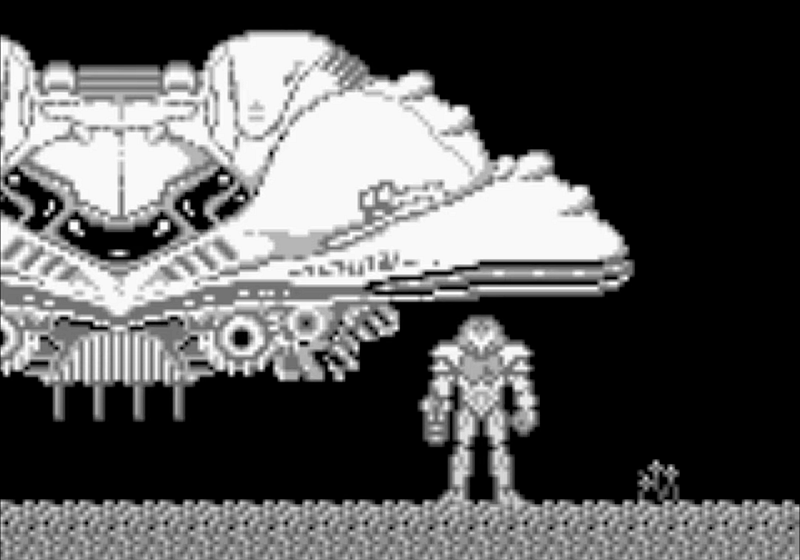
The player will notice several improvements over the original Metroid : more firing options (you can shoot up and down, while walking or jumping), better controls (better jump physics, you can kneel…), impressive sprites for a Game Boy game, great variety of structures and enemies… This is clearly, on the technical part, a great sequel and improvement from the first Metroid, where Samus was some sort of an “alien” sprite, with clunky physics and few movement options.
You will notice quickly the existence of save stations, a hallmark of the franchise too, where you can save your progression. Something that was made possible by the inclusion of a small battery within the Game Boy cartridge. A great improvement over the “code-saving” system.
And then comes the first battle with a Metroid after walking across several corridors. People who have played the first game will be familiar with the shape of the creature : a small jellyfish creature. But once you start to walk near the creature the game freezes, an eerily music starts to play and the creature leaves its shell to become some sort of a small insect with some sort of antenna, legs and shell below. A nightmarish vision when I was a child. These are the first forms of Metroids you will encounter on the planet. Then you have the Alpha, Gamma, Zeta, Omega and the Queen in the final battle. They require a different number of missiles to destroy them, between 5 (Alpha) and 40 (Omega). Like the other elements in the game, the Metroids sprites are well detailed. Regarding the “quality” of Metroid battles, I have to say that there are not “boss-level” ones. The fact is that you have 38 of them to kill across the planets. While the original creators have never expressed their choices, I do believe it was better to have “simpler” battles, than 38 “boss-like” battles : a pitfall that the remake released on the 3DS followed. The battles are too numerous, difficult and complex.
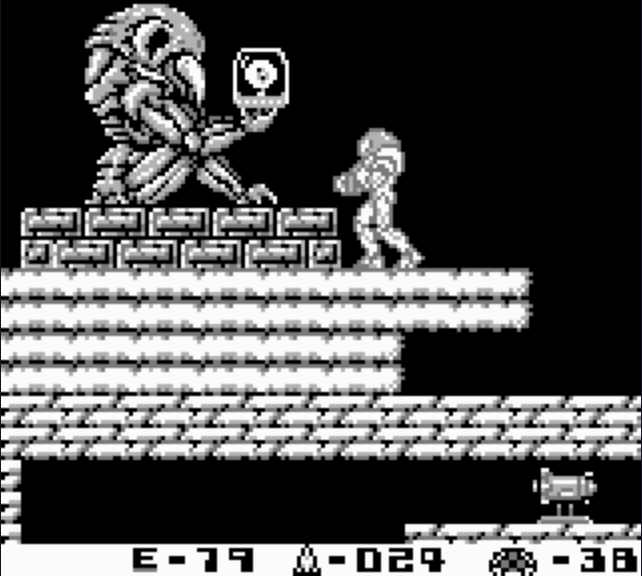
The first battle, set apart to the surprise of players of the original Metroid, is also useful to understand the mechanisms of battle with Metroids. Hence the first Metroid dies, the planet is shaken by an earthquake. This mechanic of the game is that once you kill all the Metroids in a given zone, the blocking lava disappears to allow the player to progress. Many have criticized this mechanism because it is not explained and feels arbitrary : why and how ? The Metroid 2 remake for the 3DS introduces a nice addition on this topic : the idea that the Chozo (the iconics bird-like creatures of the Metroid franchise) who are believed to have created the Metroids, sealed several parts of the planet when they decided to leave it after their creation became out of control.
While the idea here is not to debate ethics/morals in video games : we can ask ourselves about what we do in this video game. The fact is that we are wiping out an entire species in their own homeworld. More puzzling is the fact that these creatures are never attacking us randomly : this is always the player which is hunting them and entering their small nests. While these creatures are far from being “humanistic” (they have successfully emptied an entire planet and destroyed all developed forms of all life on SR388 by themselves like the Aliens), the fact is that they were not really going to leave by themselves this planet to exterminate the universe. This fact combined with the atmosphere of isolation, dread and silence, make the game even more eerier.
The topic on the moral/ethic questions surrounding the game is illustrated in depth by the section of this article (https://www.gamedeveloper.com/audio/a-maze-of-murderscapes-metroid-ii) : “The mention of genocide brings us to one of Metroid II’s themes. Playing as a cold, lonely figure, you comb through the ruins of a long-dead avian species and kill in ecoscapes evoking claustrophobia and agoraphobia. It would be dishonest to overlook that Metroid II is about the genocide of the metroids, an extraterrestrial species that is already nearly extinct. The game’s premise of systematic extermination cannot be denied, yet Metroid II turns out to be an anti-genocide game where the initial goal is to commit fantasy genocide against goofy-cute science-fiction creatures.”
The alien world
While the early parts of the game were “lighter”, the next parts are more dark and mysterious. Many of them are in fact past complex and great caves probably constructed by the Chozo : abandoned buildings, tunnels, pits, statues… With no life in sight set apart the very small creatures wandering across these sections, and the Metroids. And more importantly : only subtle sounds mimicking waterdrop or insect noise in deserted environments. From my perspective, this is very great storytelling : when the lack of sounds tells more than the abundance of it. Like I said earlier, this is surprising that the game was intended for children, because the atmosphere in many caves is eerie. While the game is not violent, this is far less comforting/funny than Tetris, Mario, Donkey Kong or even Mystic Quest. You are alone for a long time, with nearly no sounds or enemies and only the Samus footsteps sound. The “alienness” of the game I was speaking of earlier.
The player can perfectly understand that something serious occurs for such a planet with so many complex structures to be abandoned and only populated with tiny creatures. This makes the Metroid threat even more tangible : they are so powerful that what remains are only harmless creatures. Because the game is reputed to have been inspired by the Alien franchise, I can say that when you wander alone in this huge complex and caves, you feel the loneliness of the Marines entering the Hadley Hope complex. Devastation and emptiness everywhere, with no sights of survivors. And more importantly : no clues about what causes that. Because Samus sprites are quite large, the environment feels “zoomed-in” with few immediate sight. It creates a claustrophobic atmosphere. For example, when you “free-fall” along the long shaft of the Chozo ruins, you always wonder what you are going to find below. This effect is used in several zones where some Metroids are hiding deep inside pits, surprising you during your freefall.
AM2R, while “brighter” with colors, is relatively faithful to the original game atmosphere; even we added some boss battles for modern players. The 3DS remake totally misses the point on this topic : no isolation, too many battles and enemies (was the planet ever abandoned ?) and worst of all : a nonsensical battle with Ridley at the end.
These SR388 sections are also important because this is where you find several powerups : Spider Ball to walk along the walls, High Jump boots, Space Jump, Jump ball, energy tanks, missiles reserves… and a hallmark of the franchise : the Varia suit. Because GameBoy doesn’t have a color palette, the designers had to draw a large armor for Samus with the iconic shoulders. Set apart from the Spider Ball, nearly all of these upgrades were included in following games.
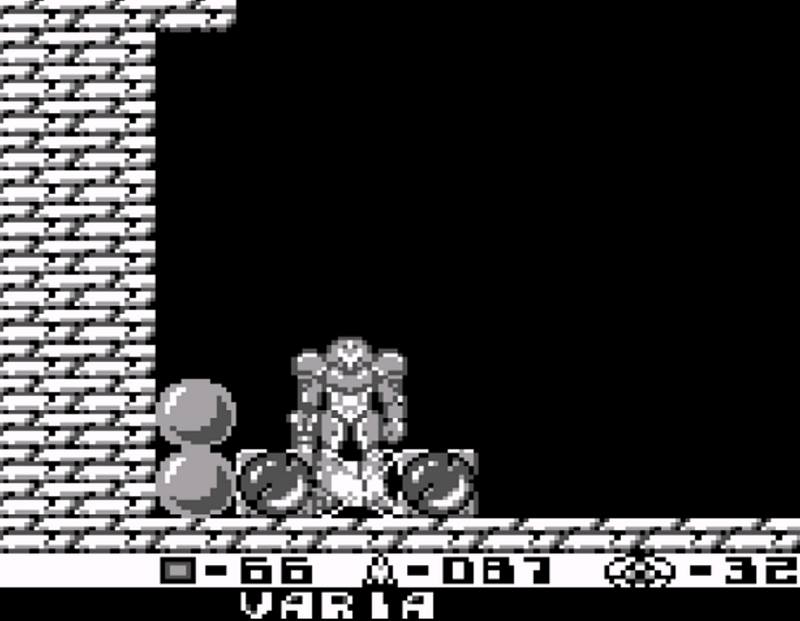
While you will find no in-game explanations of what was the use of these complexes and caves, you will notice that each of them has its distinctive straits. Some of them are just small temples built by the mysterious Chozo with the iconic statues inside. One of them seems to be some sort of an old hydro-power station with water zones and several tubes the player can go through to explore the ruins. The last complex is a gigantic tower containing several weapons. You also have a whole area looking like a deep underground forest where many Metroids are hiding. In several caves, sand was added to create a feeling of abandonment with old complexes buried in the sands. While it’s a Game Boy game, the environment and buildings give an impression of something that was working in the past.
The “Secret worlds”
Unknown to many players : the Chozo ruins are the best place to enter what is called “Secret Worlds” in Metroid 2. Because of the way the game was encoded within the cartridge, the map is somewhat compressed into several tiny rooms and used according to player position. While you are moving normally within the game, it means that in memory you near other locations within the game.
The following article (https://tasvideos.org/GameResources/GB/Metroid2) explains the point clearly : “The ROM has the game map stored in a series of 7 grids, each being a 16×16 grid of rooms (a room being a 16×16 grid of tiles, a tile being a 16×16 grid of pixels). The various sections of the game are stored in these grids mostly independent of each other, hooked up mainly by a series of “warp rooms” (see Warping). This means that locations that are far apart on the game map can be sitting right next to each other on the storage grids! Unless you are in a warp room, using the select glitch will take you to the room bordering the one you are in, whether it be another part of the game map or one of the many secret worlds. Side note: Generally, each grid follows a theme of sorts; for example, grid 1 contains the exteriors for the first four ruins while grids 5 and 6 contain the interiors of said ruins.” To exploit this possibility, some players have discovered the “Select Glitch”.
The way blocks are displayed in the game means that if you overflow the memory of the cartridge, by pressing the select button, some blocks won’t appear at all or not in the right place, creating holes. And if you take those passages, you can enter totally disconnected areas in the game : like moving from a Chozo statue room to the Queen nest. Because the rooms are not properly loaded, the sprites are totally random, leading to some “artistic” environments. But unfortunately for speed-runners, the developers have hard-coded all rules to end the game or kill the Metroids, meaning that you can be stuck in a “soft-lock” : either not being able to end the game even if the Metroid-counter is at zero or not able to move to previous areas to kill the remaining Metroids.
The fact is that it was probably difficult for the programmers to make sure that the players never skip an area or a Metroid fight. You will notice several things across the game to make sure the player is never missing the script. The entrance of the planet (where you started the game) is closed after the final boss fight. You can’t access the last area even if you have enough energy to go through the lava because the developers have put artificial spikes to block any progression. The shaft in the final boss room to escape if you run low on energy is closed once the battle ends.
The tension building-up
With the metroid-counter dwindling, you walk through emptier and emptier corridors/caves until entering the latter section. At this point, the music tone is extremely dark and creates a sense of dread. All the small creatures have vanished. You are alone exploring a creepy zone with no small enemies and barely one save station. The texture is quite weird, reminding the “bubble and sticky like” texture of the Alien nests in the eponymous franchise with some watery matters : something impressive for a GameBoy game. No energy/missiles re-filling balls too like in previous. The area is in fact only populated with the most dangerous Metroids : Omega ones. You have 3 of them. Once you have killed them, you can progress toward the end section of the game. This is a long section with no enemies and only sticky watery matter in some parts. After this long walk, you finally enter a gigantic empty cave filled with weird and harmless insectoid-like creatures. While climbing the gigantic cave, you find several textures reminiscent of the previous complex structures left by the Chozo earlier in the game. You have three shafts. The first one gives you access to both missiles and energy refilling stations. The third one allows you to pursue the final part. The second one, in between the two others, is perhaps the most chilling : you find a broken Chozo statue with the head decapitated and an arm on the ground holding a power-up ball. This is also a great example of story-telling : whatever is ahead, it was enough (and willing) to tear off this statue.
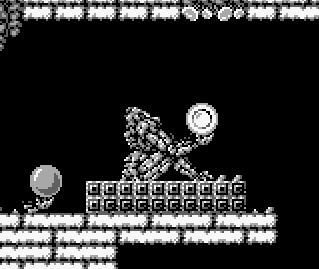
The shaft leading to the final part of the game is perhaps the most cinematic one, with an eerie music. You enter a very small shaft and discover an egg above you. While rolling below the egg, the game suddenly freezes and the metroid-counter is incremented by multiple other Metroids ! The next Metroids are flying jellyfish in the first game. They are easy to kill but are quick enough to grab you and drain your energy. While not explicit, the whole area really looks like a laboratory with tubes and weird objects used to build the place. Could it be where the Metroids were created ? Once you have killed all the remaining Metroids in the area, you can finally move to the next and final fight : the Queen Metroid.
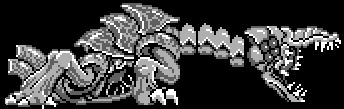
The monster is gigantic, requiring nearly 100 missiles to kill it. This is the only and true boss in the whole game, with a complex pattern of movement and attack. You can either battle her with a war of attrition, or also use the morph ball to drop bombs within her body. A small hole allows for the player to leave if the battle is too difficult. Once she dies, this hole is closed and you can only move to the next room. The famous egg you have spotted earlier hatches and you have this tiny Metroid circling around you :
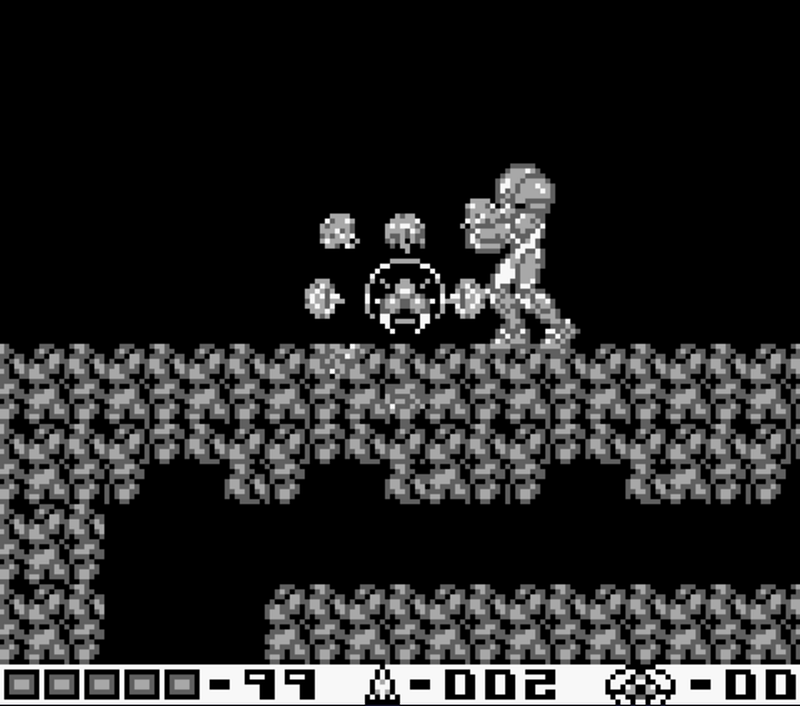
This single moment is probably the most important in the whole Metroid franchise : this is the moment when Samus refused to fulfill her mission on SR388 and spare the life of this Metroid. If the baby Metroid was not there, and if he was not killed, you won’t have all the subsequent Metroid games. And certainly not Super Metroid in the first place. Because many of the subsequent plots are linked to this event.
Once the Metroid egg hatches, the music playing is extremely peaceful and you go through the last corridors with the baby helping you by eating some sort of small blocks blocking the way to your ship. For some players, this was probably some sort of “meditating” time. After spending the whole game hunting and killing Metroids, we finally leave the planet while taking care of the last one. The developers probably didn’t expect this kind of philosophical statement, but the fact is that it probably emerged in the head of many players.
AM2R and Metroid 2 remake for the 3DS do a nice job by revisiting the end of the game. In Metroid Fusion, the game begins with Samus assisting scientists on SR388 years after her mission to destroy the Metroids, where she is attacked by a mysterious parasite trying to mimic her : the X parasite. Later in the game, we learned that the X natural habitat was SR388 and that the Metroids were probably engineered to destroy them. In the AM2R and Metroid 2 remake for the 3DS, once the game ends, a small scene is added where we first see a small creature walking on the ground of SR388. Then, the crystal-like structures eaten by the baby Metroid at the end of Metroid 2 on Game Boy in the final corridor starts to transform into a small flying and yellowish creature that merges with the small creature and starts to mimic it.
 Simon CHABROL
Laisser un commentaire