
The United Kingdom has a long and complex manufacturing history, rooted in the Industrial Revolution, when it became the world’s first industrial nation. Throughout the 19th and early 20th centuries, British industry dominated global trade in textiles, steel, shipbuilding, and engineering. However, from the late 20th century onwards, the sector experienced a significant decline in employment and relative economic weight, as production shifted toward lower-cost countries and the UK economy became increasingly service-oriented. The share of manufacturing value added fell markedly over time, reflecting broader trends seen across advanced economies. Despite this contraction, the UK retained strong capabilities in high-value sectors such as aerospace, automotive, and advanced engineering. Crucially, the boundary between manufacturing and services blurred, with design, R&D, and technical services becoming integral to industrial output. This transformation laid the foundation for a more specialized and innovation-driven industrial base. Rather than disappearing, British manufacturing evolved toward complexity and quality. Today, it is better understood as part of a broader value chain rather than a standalone sector. This historical trajectory is essential to understanding its current positioning.
Le Royaume-Uni possède une longue histoire industrielle, enracinée dans la révolution industrielle, période durant laquelle il devient la première nation industrialisée. Au XIXe et début du XXe siècle, l’industrie britannique domine le commerce mondial dans le textile, l’acier et la construction navale. À partir de la fin du XXe siècle, le secteur décline fortement en termes d’emploi et de poids économique, avec des délocalisations vers des pays à bas coûts et une tertiarisation de l’économie. La part de la valeur ajoutée industrielle diminue nettement, comme dans d’autres économies avancées. Malgré cela, le Royaume-Uni conserve des positions fortes dans des secteurs à haute valeur ajoutée comme l’aéronautique et l’automobile. La frontière entre industrie et services s’est estompée, intégrant design, R&D et services techniques. Cette mutation a permis l’émergence d’une industrie plus spécialisée. L’industrie britannique ne disparaît pas, elle se transforme. Elle s’inscrit désormais dans des chaînes de valeur complexes. Cette trajectoire historique est clé pour comprendre sa situation actuelle.
By 2025–2026, UK manufacturing will remain a relatively small but strategically important part of the economy, accounting for around 8–9% of total output and employing approximately 2.6 million people. The country ranks among the top global manufacturing nations, with strong export orientation toward both Europe and the United States. The sector is characterized by a dual structure: large-scale advanced industries coexist with a dense ecosystem of small and medium-sized manufacturers specializing in high-quality, niche, and often heritage-based production. Recent years have been marked by significant challenges, including geopolitical uncertainty, supply chain disruptions, and rising energy and labor costs. At the same time, there are clear signs of resilience and recovery, with improving demand and renewed business confidence. Government policy increasingly emphasizes advanced manufacturing, skills development, and technological innovation. The sector is also benefiting from trends such as reshoring, sustainability, and demand for traceable production. As a result, British manufacturing is defined less by scale than by specialization and value creation. This context explains the emergence of “industrial gems” — companies that remain locally anchored while competing globally.
En 2025–2026, l’industrie manufacturière britannique représente une part relativement modeste mais stratégique de l’économie, avec environ 8–9 % du PIB et 2,6 millions d’emplois. Elle figure parmi les principales puissances industrielles mondiales, avec une forte orientation export. Le secteur présente une structure duale : de grandes industries avancées coexistent avec un tissu dense de PME spécialisées dans des productions de niche et souvent patrimoniales. Les dernières années ont été marquées par des défis importants (géopolitique, chaînes d’approvisionnement, coûts). Mais des signes de reprise apparaissent avec une amélioration de la demande. Les politiques publiques mettent l’accent sur l’industrie avancée et les compétences. Le secteur bénéficie aussi de tendances comme la relocalisation et la durabilité. L’industrie britannique se distingue moins par le volume que par la valeur. Ce contexte explique l’émergence de “gems industrielles”, des entreprises ancrées localement mais compétitives globalement.
Abraham Moon & Sons
Abraham Moon & Sons is one of the last fully vertical woolen mills in Britain, operating continuously in Yorkshire since 1837. The company controls every stage of production, from dyeing raw fiber to spinning, weaving, and finishing fabric. This vertical integration ensures exceptional quality and traceability, which are increasingly valued in premium markets. Moon supplies high-end fashion brands and interior designers globally. Despite decades of industry decline, it has preserved its entire manufacturing base in the UK. The firm invests in both modern machinery and traditional expertise. It also prioritizes British wool sourcing, supporting domestic agriculture. Its resilience demonstrates how heritage industry can remain competitive. The company represents a model of localized, high-value production. It stands as a benchmark of British textile continuity.
Abraham Moon & Sons est l’une des dernières filatures lainières entièrement intégrées au Royaume-Uni, en activité depuis 1837. L’entreprise maîtrise toutes les étapes de production, de la teinture au tissage. Cette intégration garantit qualité et traçabilité. Elle fournit des marques de mode et des designers internationaux. Malgré le déclin du secteur, elle a conservé toute sa production au Royaume-Uni. Elle investit dans la technologie et le savoir-faire. Elle valorise la laine britannique. Sa résilience illustre la compétitivité des industries patrimoniales. Elle incarne un modèle local à forte valeur ajoutée. C’est une référence du textile britannique.
— UK Manufacturing Overview (2025–2026)
A small but strategic sector
- ~8–9% of UK GDP
- ~£220–250bn annual output
- ~2.6 million jobs
- Top 10 global manufacturing nation
- Strong export orientation
Un secteur modeste mais stratégique (~8–9% du PIB, ~2,6M emplois), fortement tourné vers l’export et toujours dans le top 10 mondial.
Harris Tweed Hebrides
Harris Tweed Hebrides produces one of the most protected textiles in the world under strict legal definition. Every piece must be handwoven in the Outer Hebrides by local islanders. This unique decentralized model sustains fragile rural economies while preserving skills. The company blends heritage patterns with contemporary design collaborations. It exports globally but remains deeply rooted in place. Its production cannot be offshored by law. Harris Tweed benefits from strong authenticity and storytelling. It is widely used in luxury fashion and interiors. Investment in design has renewed its relevance. It exemplifies how regulation can protect industrial ecosystems.
Harris Tweed Hebrides produit un textile protégé par la loi. Chaque pièce est tissée à la main dans les Hébrides. Ce modèle soutient les économies locales. L’entreprise allie tradition et design contemporain. Elle exporte tout en restant ancrée localement. Sa production est non délocalisable. Elle repose sur une forte authenticité. Elle est utilisée dans le luxe. L’innovation a renouvelé son attrait. Elle montre comment protéger une industrie.
— Historical Shift
From industrial powerhouse to specialization
- Birthplace of the Industrial Revolution
- Peak industrial dominance (19th–early 20th c.)
- Sharp decline post-1980s
- Shift toward services economy
- Surviving core = high-value sectors
D’une puissance industrielle dominante à une économie spécialisée, avec un recentrage sur les secteurs à forte valeur ajoutée.
Johnstons of Elgin
Johnstons of Elgin is a leading Scottish producer of cashmere and fine wool textiles, founded in 1797. It operates mills in Scotland where all key manufacturing stages are carried out. The company supplies top luxury houses and sells under its own brand. Its expertise in fiber selection and finishing is globally respected. It has maintained full local production despite global competition. Sustainability and traceability are increasingly central to its strategy. The firm invests in skills and apprenticeships. It balances innovation with centuries-old techniques. Its products embody durability and refinement. It remains a cornerstone of British luxury manufacturing.
Johnstons of Elgin est un producteur écossais de cachemire fondé en 1797. Il fabrique en Écosse. Il fournit des maisons de luxe. Son expertise est reconnue. Il a maintenu sa production locale. Il investit dans la durabilité. Il forme des artisans. Il combine tradition et innovation. Ses produits sont durables. Il est un pilier du luxe britannique.
— Key Industrial Sectors
High-value, export-driven
- Aerospace (global leader)
- Automotive (premium positioning)
- Pharmaceuticals & chemicals
- Advanced engineering
- Food & beverage manufacturing
Des secteurs industriels à forte valeur, souvent exportateurs, dominés par l’aéronautique, l’automobile et la pharma.
Brompton Bicycle
Brompton Bicycle manufactures folding bicycles entirely in London, maintaining a strong commitment to domestic production. Founded in 1975, it has become a global leader in urban mobility. Its factory combines automation with skilled manual assembly. The company exports to dozens of countries while keeping production local. Its design prioritizes durability, repairability, and compactness. Brompton has invested heavily in expanding its UK manufacturing capacity. The brand is closely associated with British engineering excellence. It appeals to professionals and commuters worldwide. Its success shows that manufacturing can thrive in major cities. It represents modern industrial resilience.
Brompton Bicycle fabrique ses vélos à Londres. Fondée en 1975, elle est leader de la mobilité urbaine. Elle combine automatisation et assemblage manuel. Elle exporte largement. Elle privilégie durabilité et réparabilité. Elle investit dans ses capacités locales. Elle incarne l’ingénierie britannique. Elle séduit une clientèle urbaine. Elle prouve que l’industrie peut rester en ville. C’est un succès industriel moderne.
— Trade & Exports
A globally integrated industry
- ~45–50% of output exported
- Key markets: EU, USA
- Strong specialization in premium goods
- Trade deficits in some segments
- High reliance on global supply chains
Une industrie très ouverte, avec près de la moitié de la production exportée, mais dépendante des chaînes globales.
Morgan Motor Company
Morgan Motor Company produces handcrafted cars in Malvern, England, using a blend of traditional and modern techniques. Founded in 1909, it has retained a strong local manufacturing base. Its vehicles feature wooden frames combined with contemporary engineering. Production volumes are deliberately low to ensure quality. Each car is highly customizable. Morgan has resisted full industrial standardization. It exports to niche global markets. The company emphasizes craftsmanship and heritage. Its factory is also a tourist destination. Morgan represents artisanal manufacturing in the automotive sector.
Morgan Motor Company fabrique des voitures artisanales en Angleterre. Fondée en 1909, elle produit localement. Elle combine bois et technologie moderne. Les volumes sont faibles. Chaque voiture est personnalisée. Elle refuse la standardisation. Elle exporte vers des marchés de niche. Elle valorise l’artisanat. Son usine est visitable. Elle incarne l’automobile artisanale.
— Industrial Structure
Dual model
- Large global groups (BAE, Rolls-Royce…)
- Dense SME ecosystem
- Many niche manufacturers
- Strong regional clusters
- Supply chain fragmentation
Un modèle dual : grands groupes + tissu dense de PME spécialisées, souvent organisées en clusters régionaux.
Crockett & Jones
Crockett & Jones manufactures premium shoes in Northampton, the historic center of British shoemaking. Founded in 1879, it employs skilled artisans in its local factory. The company maintains tight control over production quality. Its shoes are made using traditional Goodyear welting techniques. It serves both retail customers and luxury brands. International demand remains strong. The firm limits growth to preserve standards. It invests in training and craftsmanship. Its products are built for longevity. Crockett & Jones represents enduring British manufacturing excellence.
Crockett & Jones fabrique des chaussures à Northampton. Fondée en 1879, elle emploie des artisans. Elle contrôle sa production localement. Elle utilise des techniques traditionnelles. Elle sert le luxe. Elle exporte fortement. Sa croissance est maîtrisée. Elle forme ses équipes. Ses produits sont durables. Elle incarne l’excellence britannique.
— Regional Clusters
Geography still matters
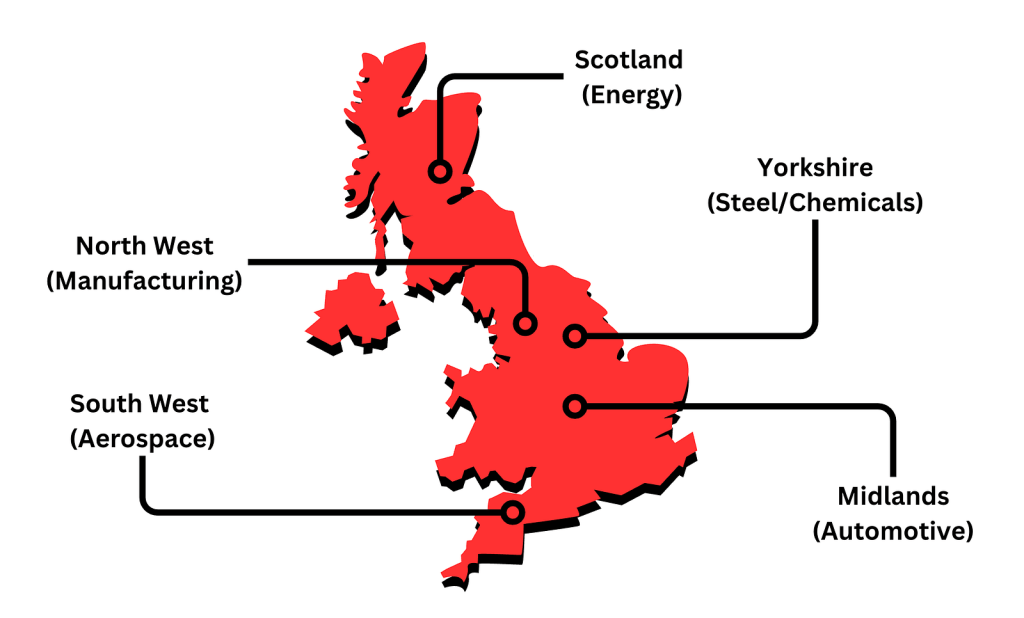
- Midlands → automotive
- North England → textiles & materials
- Scotland → energy & engineering
- South → aerospace & tech
- Stoke-on-Trent → ceramics
Des pôles industriels régionaux historiques encore très structurants.
Loake
Loake is a long-established shoemaker producing premium footwear in Northamptonshire since 1880. Its English-made range continues to be manufactured locally. The company specializes in Goodyear-welted construction. It emphasizes durability and repairability. Loake exports globally while preserving local skills. It balances tradition with modern retail distribution. The brand is known for reliability and craftsmanship. It maintains a strong factory workforce. Its products appeal to both classic and modern consumers. Loake reflects continuity in British industrial heritage.
Loake est un fabricant de chaussures fondé en 1880. Il produit encore au Royaume-Uni. Il est spécialisé dans le cousu Goodyear. Il valorise la durabilité. Il exporte mondialement. Il combine tradition et distribution moderne. Il est reconnu pour sa qualité. Il maintient une main-d’œuvre locale. Il attire divers clients. Il incarne la continuité industrielle.
— Recent Challenges
Pressure on competitiveness
- Brexit-related frictions
- Energy cost increases
- Labour shortages
- Supply chain disruptions
- Investment gaps vs EU/US
Des pressions fortes sur la compétitivité : coûts, Brexit, tensions sur l’emploi et les chaînes d’approvisionnement.
Fox Brothers
Fox Brothers is a historic cloth manufacturer in Somerset, producing wool fabrics since 1772. It is credited with inventing flannel. The company continues to manufacture in England. It supplies luxury tailoring houses worldwide. Its fabrics are deeply linked to British sartorial tradition. Fox Brothers has modernized while preserving heritage techniques. It remains relatively small but influential. Its archives inspire new collections. The firm emphasizes sustainability and longevity. It is a key player in textile heritage.
Fox Brothers est une filature du Somerset fondée en 1772. Elle a inventé la flanelle. Elle produit toujours en Angleterre. Elle fournit le luxe. Ses tissus sont liés au tailoring. Elle a modernisé ses procédés. Elle reste influente. Ses archives inspirent le design. Elle valorise la durabilité. Elle est centrale dans le patrimoine textile.
— Current Trends (2025–2026)
Signs of resilience
- Reshoring & local production
- Automation & digitalization
- Sustainability push
- Skilled labor shortages persist
- Gradual recovery in demand
Un secteur en mutation : relocalisation, digitalisation, durabilité, avec des signes de reprise malgré des contraintes.
Ercol
Ercol is a British furniture manufacturer known for high-quality wooden furniture, with production still based in the UK. Founded in 1920, it combines traditional woodworking with modern design. The company has maintained domestic manufacturing for key product lines. It emphasizes craftsmanship and material quality. Ercol has become a reference in British interior design. Its production processes balance machinery and hand-finishing. The brand exports internationally while preserving local roots. Sustainability is increasingly important in sourcing and production. Its longevity reflects consistent design values. Ercol represents excellence in British furniture manufacturing.
Ercol est un fabricant britannique de meubles fondé en 1920. Il produit encore au Royaume-Uni. Il combine artisanat et design moderne. Il maintient une production locale pour ses pièces clés. Il valorise la qualité des matériaux. Il est une référence du design intérieur. Il combine machines et finitions à la main. Il exporte à l’international. Il intègre la durabilité. Il incarne l’excellence du meuble britannique.
— The Rise of “Industrial Gems”
Small, local, high-value players
- Heritage + innovation
- Local production maintained
- Premium positioning
- Export-driven niche markets
- Strong brand & storytelling
Émergence d’acteurs de niche combinant ancrage local, production maintenue et positionnement haut de gamme.
Emma Bridgewater
Emma Bridgewater is a British pottery manufacturer based in Stoke-on-Trent, the historic heart of the UK ceramics industry. Founded in 1985, the company has remained committed to local production, with all its pottery made and hand-decorated in England. It specializes in earthenware that combines traditional techniques with distinctive, contemporary patterns. The brand has built a strong identity around craftsmanship and everyday usability. Its factory employs skilled decorators and artisans, preserving regional know-how. Emma Bridgewater has also invested in training and apprenticeships. The company attracts both domestic and international customers. It emphasizes durability and emotional attachment to objects. Its production model resists outsourcing. It represents the revival of British ceramics manufacturing.
Emma Bridgewater est un fabricant britannique de céramique basé à Stoke-on-Trent. Fondée en 1985, elle produit et décore toutes ses pièces en Angleterre. Elle combine techniques traditionnelles et motifs contemporains. Elle valorise l’artisanat et l’usage quotidien. Elle emploie des artisans qualifiés. Elle investit dans la formation. Elle attire une clientèle internationale. Elle met en avant la durabilité. Elle refuse la délocalisation. Elle incarne le renouveau de la céramique britannique.
— Conclusion
A specialized, resilient manufacturing model
- High-value over volume
- Strong niche positioning
- Local production persists
- Innovation + heritage combined
- Global competitiveness maintained
Un modèle industriel fondé sur la valeur plutôt que le volume, combinant ancrage local, spécialisation et compétitivité internationale.
 Simon CHABROL
Laisser un commentaire